Ancient mosaic uncovered in Smyrna after 70 years
Excavation and restoration works in Smyrna continue uninterrupted throughout the year within the scope of the Turkish Ministry of Culture and Tourism’s “Heritage for the Future Project.”
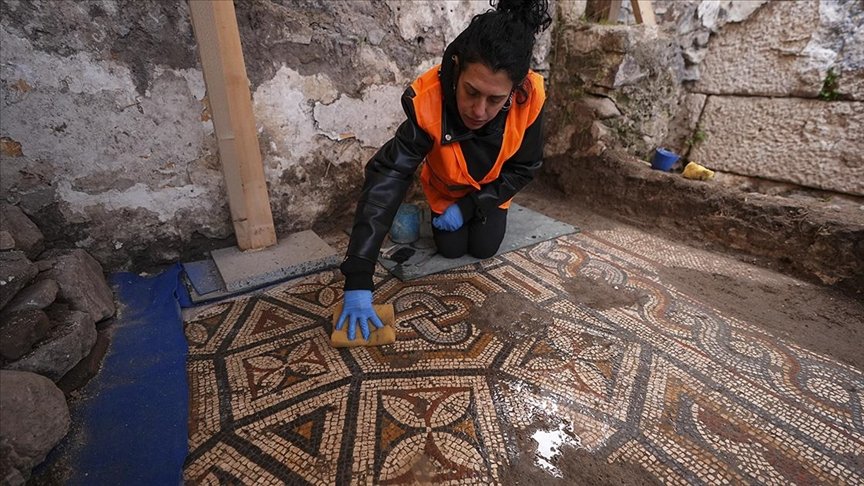
During excavations carried out on the North Street of the Smyrna Agora, a mosaic floor measuring approximately 3 by 4 meters and decorated with twelve interlocking polygonal panels was discovered, CE Report quotes Anadolu Agency.
The “Solomon’s knot” motif located at the center of the mosaic drew particular attention.
Mosaic floor discovered after 70 years
Excavation Director Prof. Dr. Akın Ersoy, a faculty member of the Department of Turkish-Islamic Archaeology at İzmir Katip Çelebi University, told Anadolu Agency that Smyrna was a planned city established after Alexander the Great.
Ersoy stated that excavations in the city are concentrated in the Smyrna Agora and the Theatre, noting that the mosaic floor has begun to emerge during works conducted on the Agora’s North Street.
He explained that in Late Antiquity (4th–6th centuries AD), a structure was built in this area, which had been one of the city’s major streets in the Ancient Period, and that it has not yet been determined whether the building served as a private residence or a public space.
Recalling that a “mosaic hall” had previously been identified in the Smyrna Ancient City, Ersoy said that uncovering a new mosaic pavement after approximately 70 years was surprising for the team.
A symbol against the “evil eye” in antiquity
Ersoy noted that the area is defined as a “mosaic room” and that such mosaic floors were widely used during Late Antiquity.
He stated that the mosaics feature vegetal motifs and geometric decorations, drawing attention to the “Solomon’s knot” motif at the center, and continued:
“We see the use of protective symbols in mosaics. In order to prevent envy or jealousy in such spaces, protective symbols were used either at entrances or on floors. The ‘Solomon’s knot’ is a fine example of this. There are also small cross depictions around it. These were traditions that began as decorative elements and later gained acceptance with the adoption of monotheistic religions. Ultimately, they are all protective symbols.”
Ersoy emphasized that these symbols were preferred to protect the space or its users from the “evil eye,” adding that whether the structure was a public space or a private residence, the symbols were intended to protect the city, the homeowner, or the people living there from harm.
“Mosaic room” reused after 1,500 years
Ersoy stated that the mosaic room was reused approximately 1,500 years later, in the 19th century, by a non-Muslim hospital in the area or nearby residences.
“The Late Antique mosaic pavement was uncovered, admired, and new structures were built on top of it. How do we know this? Because the plaster mortar of the walls built later was laid directly onto the mosaic. This shows that the mosaic floor continued to be used for a period even after 1,500 years,” he said.
Noting that the excavation area will be expanded, Ersoy added, “When we enlarge the area during the 2026 excavations, other spaces may also come to light.”
As reported by CE Report, Ersoy also thanked İzmir Metropolitan Municipality, Yaşar Education and Culture Foundation, İzmir Chamber of Commerce, and GüzelEnerji Akaryakıt AŞ for their support of the excavation work.