Croatia unveils 2027-2034 Industrial Development Plan
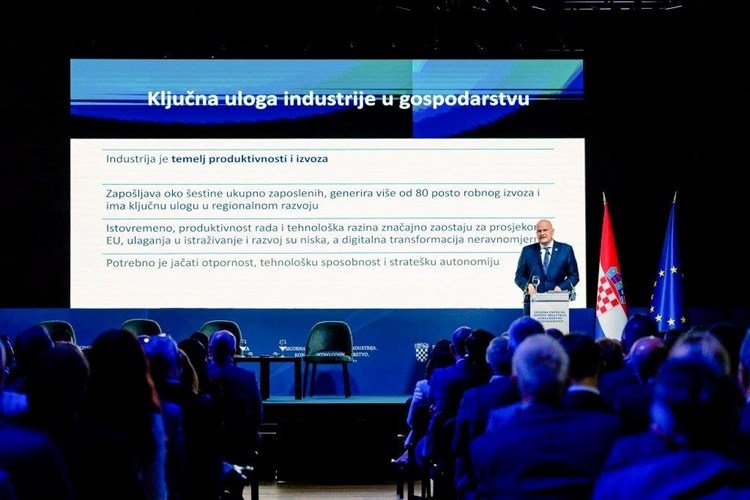
At the conference titled “Secure Energy – Strong Industry – Competitive Economy: Economic Plan for Croatia”, held in Zagreb and organized by the Ministry of Economy, the National Industrial Development Plan of the Republic of Croatia 2027–2034 was presented, along with the accompanying Action Plan for the period 2027–2030.
The plan is aimed at strengthening the competitiveness of the Croatian economy, developing higher value-added industry, and ensuring long-term sustainable economic growth, CE Report informs via the Ministry of Economy of Croatia's official website.
The conference was opened by Minister of Economy Ante Šušnjar, and addressed by the Prime Minister of the Republic of Croatia, Andrej Plenković.
The Prime Minister emphasized that through the new industrial strategy, Croatia aims to develop a digitalized and modernized industry, an energy-efficient and green industry, and an innovative and export-oriented manufacturing sector, with stronger reliance on domestic technologies and industrial capacities.
Presenting the National Plan, Minister Šušnjar stressed that Croatia must build an economy based on knowledge, technology, productivity, and secure energy.
“Secure energy, strong industry, and a competitive economy are not three separate policies. They are one chain,” said Minister Šušnjar.
He added that industrial strategy does not begin in the factory, but with available energy, clear and predictable rules, knowledge, capital, infrastructure, and confidence that long-term planning and investment in Croatia is worthwhile.
The Minister stated that the National Plan is the result of a two-year dialogue with the business sector, industry, and academic community, and a response to global changes shaping European and global industrial policy today.
“Global competition is no longer driven only by labor costs. It is driven by technology, energy, supply chain security, robotics, artificial intelligence, and the ability of the state to respond quickly to crises,” Šušnjar said.
He emphasized that Croatia must no longer be a passive observer of European reindustrialization, but an active country that uses its energy, transport, and industrial advantages.
“I want a Croatia that does not compete only on labor costs, but on knowledge, technology, and productivity. A Croatia where investments are made, where technologies are developed, and where high-value-added jobs are created,” the minister said.
He noted that the goal of the National Plan is to increase the share of manufacturing industry in the gross value added of the economy from the current 10.6% to 12.5% by 2034, along with stronger development of high-value-added industries, increased investment in research and development, and an accelerated digital and green transition of industry.
Speaking about energy policy, the minister highlighted that in the past two years, Croatia has further strengthened its energy security by increasing the capacity of the LNG terminal on the island of Krk, investing in transmission and distribution infrastructure, opening space for new investments in renewable energy sources, and creating a legal framework for long-term consideration of nuclear energy as part of Croatia’s future energy mix.
“Industry today is no longer just an economic issue. It is a matter of security, resilience, and the ability of the state to maintain its own production and technological capacities in times of crisis,” Šušnjar said.
The National Plan defines three strategic goals: developing a competitive and export-oriented industry, developing a clean and energy-efficient industry, and strengthening the resilience and security of industrial capacities.
The conference also included two thematic panels: “Industrial Transformation of Croatia: New Opportunities for the Economy” and “Energy Sovereignty Plan: The Nuclear Future of Croatia”, with participation from representatives of the business sector, academia, and the energy industry.
The Action Plan for implementing the National Plan for the period 2027–2030 was also presented, foreseeing 10 measures and 55 projects and activities with a total estimated value of around €1.9 billion, while the total planned funds for implementing the National Plan until 2034 amount to €2.9 billion.
“That money must become new equipment, new factories, new research, new products, new export opportunities, and better-quality jobs,” said Minister Šušnjar.
During the conference, contracts were also awarded to beneficiaries under the “Apprenticeship for Crafts Occupations” program, as well as financing decisions for projects under the IRI S3 program “Increasing the Development of New Products and Services Arising from Research and Development Activities.”
The minister concluded the conference by answering participants’ questions on industrial policy, investment in research, development and innovation, renewable energy sources, nuclear energy, and the future of Croatian industry, and thanked all participants for their contribution to the conference and to the daily development of the Croatian economy.
Photo: Ministry of Economy of Croatia