DNA study rewrites history of plague
Ancient plague DNA, possible signs of life on Mars, a record-breaking Chinese supercomputer, and a spider that uses a catapult-like trap were among the most notable scientific and technological developments recorded in June.
Scientific and technological advances continued to shed light on the mysteries of the universe while offering new insights into challenges facing humanity. Anadolu Agency reviewed the month's most significant discoveries, CE Report quotes Anadolu Agency.
Space and technology
NASA's Perseverance rover detected organic carbon molecules in rocks within the Bright Angel formation of Neretva Vallis, an ancient water channel that once fed Jezero Crater on Mars.
Scientists identified a form of carbon known as macromolecular carbon (MMC). While the material could be linked to ancient microbial life, researchers cautioned that it may also have formed through geological processes such as rock-water interactions or meteorite impacts.
Astronomers from the University of Oxford, the University of Birmingham, and Université Côte d'Azur also identified two giant exoplanets—TOI-791 b and TOI-791 c—located about 1,110 light-years away. Orbiting a star in the Volans constellation, the planets were described as the largest exoplanets with densities lower than cotton candy.
Meanwhile, researchers from Curtin University concluded that Australia's North Pole Dome crater was created by a meteorite impact around 3 billion years ago, making it the oldest known impact site on Earth and older than the previously recognized Yarrabubba Crater.
NASA also announced the end of its MAVEN (Mars Atmosphere and Volatile Evolution) mission after losing contact with the spacecraft on December 6, 2025, ending more than 11 years of observations in Mars orbit.
China successfully launched a new group of CentiSpace-1 satellites aboard a Kuaizhou-11 rocket from the Jiuquan Satellite Launch Center. The mission marked the 39th launch using the Kuaizhou rocket series.
China also unveiled LineShine, the world's fastest supercomputer, capable of performing 2.198 exaflops—or roughly 2.2 quintillion calculations per second. Unlike most modern supercomputers, LineShine achieves exascale performance using only central processing units (CPUs) instead of graphics processing units (GPUs).
In another breakthrough, two independent research teams—one in Europe and another in China—developed working nuclear clocks, which measure time using energy transitions inside an atom's nucleus rather than electron movements, potentially surpassing the precision of today's atomic clocks.
Health
A large Danish study found that prolonged standing, excessive walking, and frequent bending during early pregnancy may increase the risk of miscarriage.
Researchers from Bispebjerg Hospital and the University of Copenhagen analyzed more than 800,000 pregnancy records involving 475,312 women between 2004 and 2018.
The study found that every additional hour spent bending forward by at least 30 degrees during an eight-hour workday increased miscarriage risk by 36%, while each additional hour of walking raised the risk by 18%. Prolonged standing increased the risk by 3%.
Scientists also discovered evidence suggesting the earliest known plague outbreak occurred approximately 5,500 years ago.
DNA samples taken from human remains in cemeteries near Lake Baikal in southern Siberia revealed that 18 of 46 individuals carried plague bacteria, pushing back the known origin of the disease by roughly 1,700 years. Researchers believe the findings represent the oldest evidence yet of plague in humans.
Another major medical breakthrough came from an experimental treatment for pancreatic cancer.
Researchers found that patients receiving the experimental drug survived an average of 13.2 months, compared with 6.7 months for those treated with standard chemotherapy. The drug also delayed disease progression to about 7.2–7.3 months, compared with 3.5–3.6 months for chemotherapy patients, while causing fewer serious side effects.
Animal discoveries
Scientists in Queensland, Australia, identified a new species known as the "ballista spider," which exclusively hunts weaver ants by constructing a spring-loaded trap resembling the ancient ballista weapon.
Meanwhile, an international team of researchers from Italy, China, and New Zealand discovered the world's largest and deepest whale graveyard in the Diamantina region of the southeastern Indian Ocean.
During 32 deep-sea dives, scientists identified 485 whale fossil sites and five recently deceased whales at depths approaching 7,000 meters. The findings suggest the area may represent a previously unknown "whale-fall super corridor," stretching roughly 1,200 kilometers across the ocean floor.
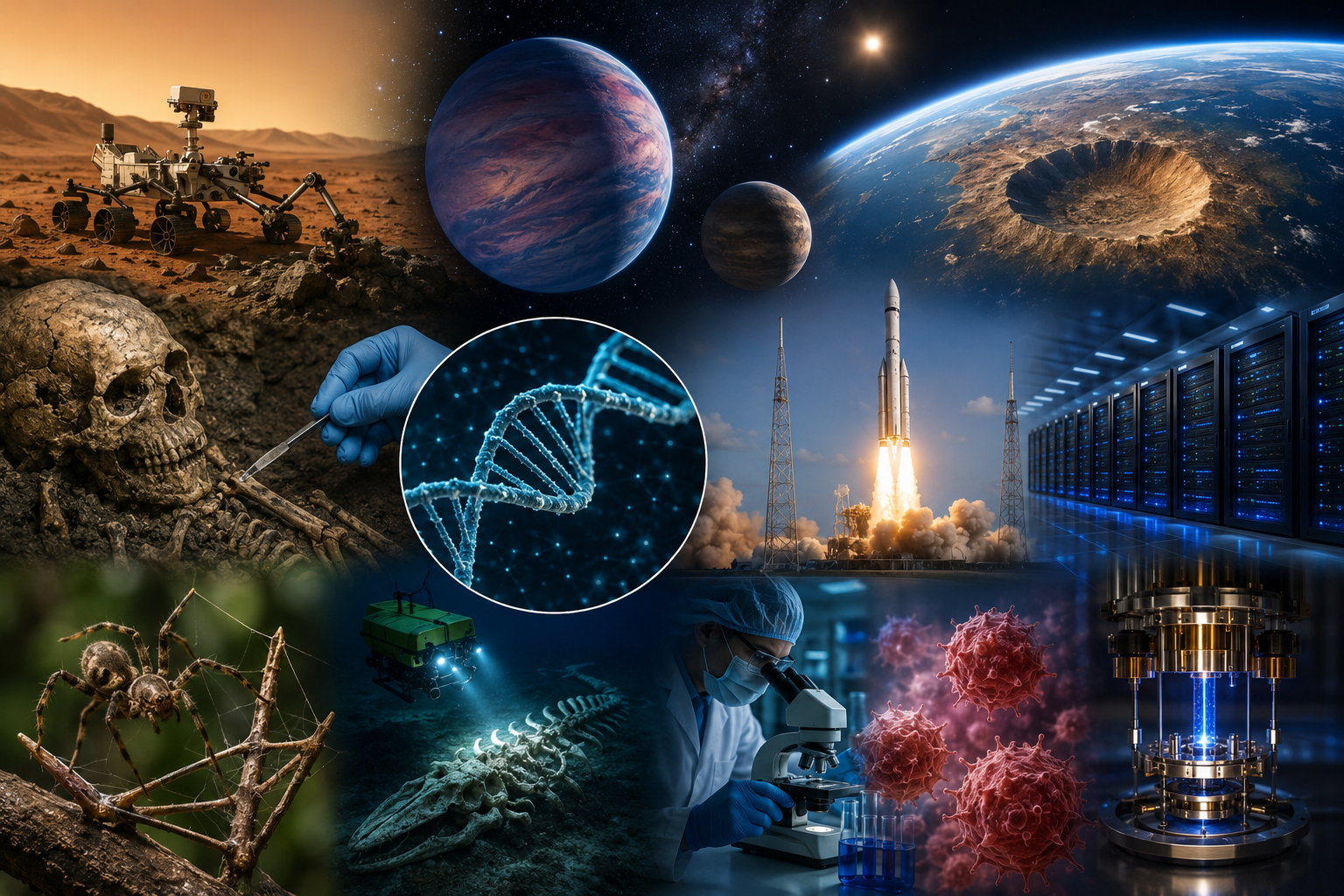
Photo: Chat GPT