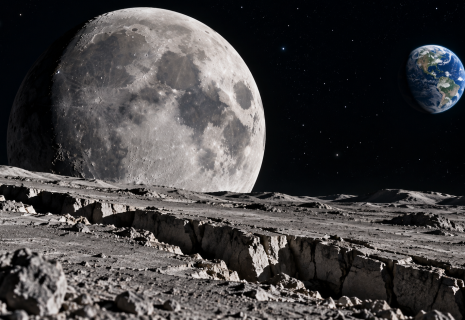
NASA crew captures unseen Lunar landscapes
Astronauts from NASA’s Artemis II mission are continuing their journey to the Moon on Sunday, having already observed regions that have never before been seen live by human eyes, AFP reports.
The Artemis II mission has already completed “two-thirds” of its journey to the Moon, NASA revealed on social media platform X, CE Report quotes AGERPRES.
“We were able to see the far side of the Moon for the first time, and it was simply spectacular,” said American astronaut Christina Koch in a televised interview from aboard the Orion spacecraft.
The Moon appeared “different” to the astronauts, explained Koch, who with this mission becomes the woman who has traveled the farthest into space.
“It wasn’t the Moon we were used to. So we took out our lunar mapping data, compared the images, and said: ‘This is the far side. It’s something we’ve never truly seen before,’” she added.
She expressed excitement about observing an “incredible geological formation, sometimes referred to as the Grand Canyon of the Moon.”
“No human eye had truly seen this crater until today, when we had the privilege to see it,” she said during a video conference organized by the Canadian Space Agency.
“We can’t wait to show you more images as we get closer to the Moon,” she added.
The four astronauts — three Americans and one Canadian — directly observed the lunar hemisphere permanently facing away from Earth, benefiting from a panoramic perspective better than that of their Apollo-era predecessors more than 50 years ago.
They managed to capture “lunar landscapes that no human eye had ever seen until yesterday,” said NASA official John Honeycutt.
Unlike Apollo missions, which flew at about 110 km above the lunar surface, Artemis II maintains an altitude of around 6,400 km, offering a wider and more complete view of the Moon, including its polar regions.
After a successful launch from Florida, the mission is heading toward the Moon, located about 400,000 km from Earth, and is expected to fly by it on Monday — a first in over half a century.
The crew will not land on the Moon but will orbit it and return to Earth, with splashdown scheduled for April 10.
During the flyby, they are expected to observe more regions never before seen directly by humans and collect valuable visual observations.
The mission aims to ensure everything is ready for future lunar landings and the establishment of a lunar base, as well as preparations for missions to Mars.