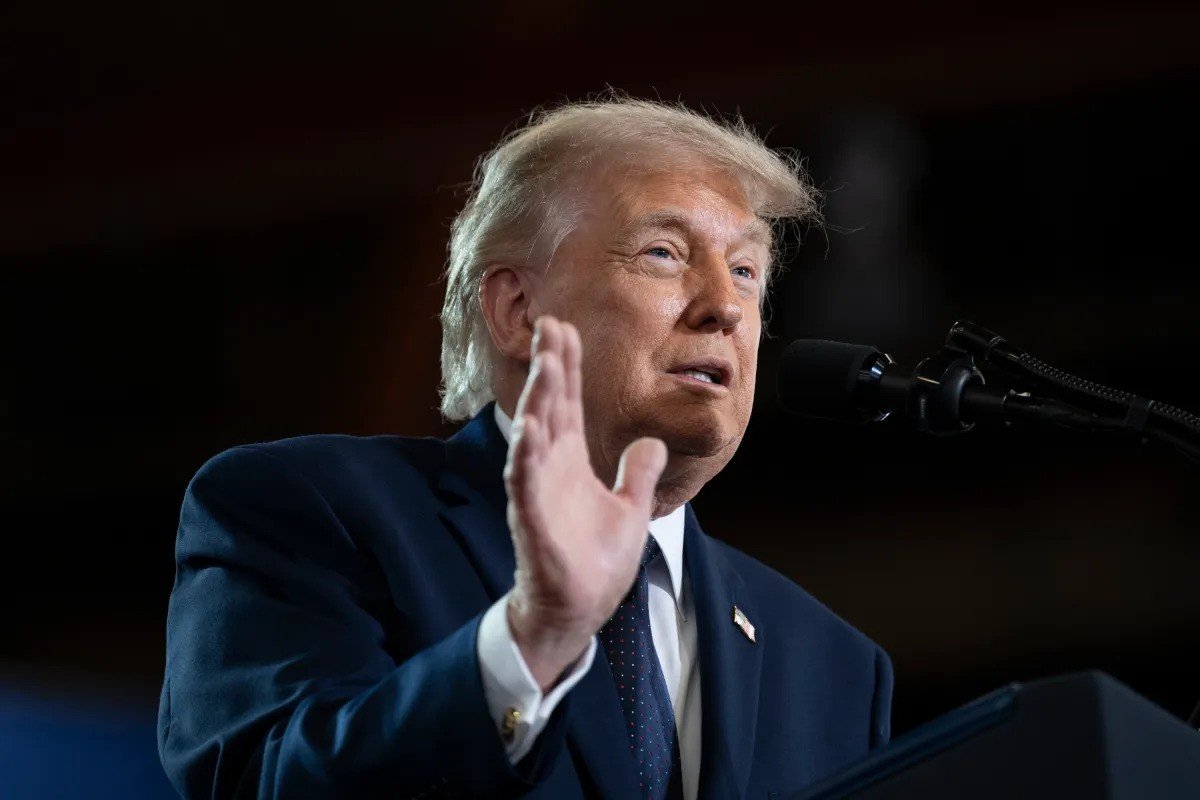
Trump threatens “terrible” economic consequences for countries helping Iran
U.S. President Donald Trump on Wednesday threatened “terrible” economic consequences against “any country” that provides assistance to Iran, further intensifying Washington’s pressure on Tehran months after the war began with U.S.-Israeli strikes on February 28, CE Report quotes ANA-MPA.
“I am announcing that any country that allows its financial institutions, businesses, airports or government institutions to provide any form of a lifeline to Iran will itself face terrible economic consequences,” Trump said in a post on Truth Social.
He accused Tehran of failing to seize the “great opportunity” he had offered to reach a “deal” with the United States.
“I am therefore announcing the most crushing economic warfare ever conducted against any country,” Trump continued, promising economic warfare and isolation “on a scale never before seen.”
He also called for an immediate halt to oil smuggling, currency exchanges, cash transfers, foreign-exchange operations, ship registries and the use of front companies, apparently warning countries suspected of providing Iran with assistance, either openly or covertly.
Trump did not specify what measures or sanctions he intends to impose.
Last week, U.S. Treasury Secretary Scott Bessent had already warned that Iran would face economic isolation on a scale “the world has never seen before.”
Although the intensity of hostilities has declined, tensions remain high in the Middle East after nearly six months of war.
With growing public and political dissatisfaction in the United States over the conflict, as well as declining stocks of several key categories of ammunition in the U.S. military’s inventory, Trump has recently appeared to adopt a more cautious approach on the military front.
Ballistic missiles
Following the joint U.S.-Israeli attack on February 28, Tehran retaliated by targeting countries in the region that are allied with Washington and later closing the Strait of Hormuz, a crucial waterway for global hydrocarbon trade. Washington responded by imposing a blockade on Iranian ports in the Gulf.
The United Arab Emirates accused Iran on Tuesday of launching two ballistic missiles toward its territory. The missiles fell into the sea and allegedly targeted “international navigation.” Iran’s Foreign Ministry denied the accusation and rejected the claim.
In response, the UAE Foreign Ministry announced the suspension, until further notice, of all “commercial exchanges” and “financial transactions” with Iran.
Meanwhile, Iranian armed forces chief General Ali Abdollahi warned Gulf countries that “any assistance or facilitation provided to the aggressor U.S. military amounts to participation in U.S. military operations,” according to the Mehr news agency.
Iran and the UAE, separated by the Strait of Hormuz, have longstanding historical and cultural ties. Before the war began, the UAE was considered a major trading partner of Iran, which is already subject to extensive U.S. sanctions.
Diplomatic efforts remain stalled
Diplomatic efforts appear to remain at an impasse.
“There are currently no discussions, talks or negotiations planned with the Islamic Republic of Iran,” Trump said on Tuesday.
According to an Agence France-Presse source in Washington, contacts have now been suspended, with Trump reportedly instructing his advisers not to continue dialogue with Tehran unless Iran moves closer to the U.S. position.
Iran, however, appears unwilling to make such a move. Iranian chief negotiator Mohammad Bagher Ghalibaf insisted on Tuesday that the Strait of Hormuz would not reopen until the U.S. administration implements commitments made under the Islamabad memorandum of understanding signed by the two countries’ presidents in June.
“The Americans think that if they put more pressure on Iran, they will obtain concessions that were never included in the agreement,” Ghalibaf said on X.
The initial agreement, which provided for a 60-day ceasefire and negotiations toward a lasting settlement, collapsed when hostilities resumed in July.
Ghalibaf, who visited Baghdad on Wednesday, also criticized what he called “foreign interference” as the U.S. administration pressures Iraq to disarm powerful Iraqi armed groups aligned with Tehran. He called for greater “regional strengthening.”
Meanwhile, Iran and Oman, located on opposite sides of the Strait of Hormuz, have been discussing the future management of the strategic waterway for several weeks.
Iran, which has been targeting vessels attempting to cross the strait without its permission, intends to introduce fees for services provided in the waterway. The proposal has been categorically rejected by the United States and several oil-exporting monarchies in the region.
Photo: White House