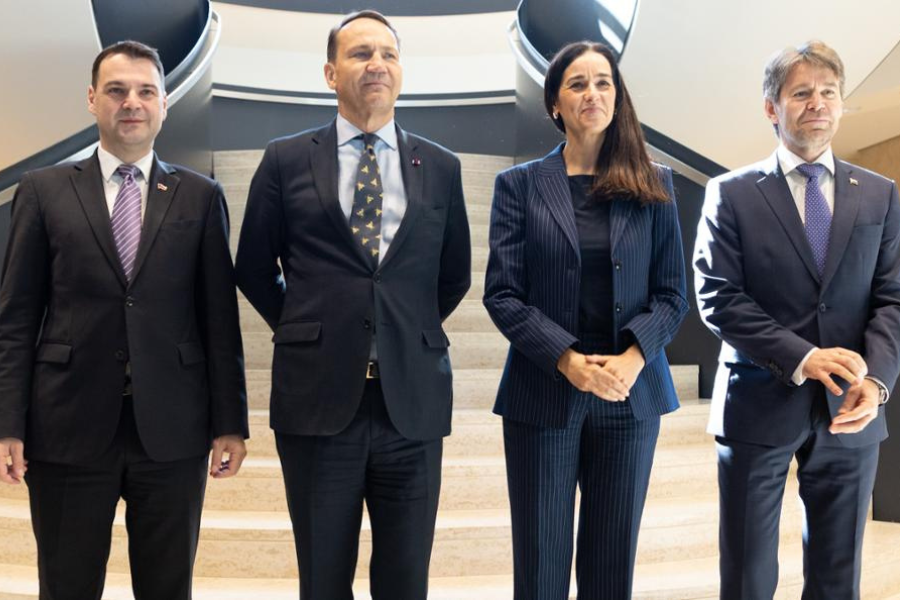
Poland calls for tougher EU sanctions on Russia at Luxembourg talks
Deputy Prime Minister of Poland Radosław Sikorski took part in the Foreign Affairs Council (FAC) meeting in Luxembourg, where he called for tougher sanctions against the Kremlin in response to intensified attacks on Ukraine and hybrid operations in Europe.
During discussions on regional security, the minister presented EU partners with a “White Paper on Russian acts of sabotage and subversion against members of the Council of the Baltic Sea States,” urging a firm response to Moscow and clear support for Armenia’s pro-Western course and for stability in the Middle East, CE Report informs via the Ministry of Foreign Affairs of Poland's official website.
Continued pressure on the Kremlin and opening of accession talks with Kyiv
During the Council meeting, Minister Sikorski called for a decisive stance toward Russia amid what he described as the Kremlin’s lack of willingness to engage in genuine peace talks. The Polish foreign minister condemned attacks on Kyiv and Kharkiv. He particularly denounced the destruction of the historic Kyiv Pechersk Lavra—a 11th-century Orthodox monastery listed as a UNESCO World Heritage Site. He said this was another act of terror exposing Moscow’s hypocrisy in claiming to defend Christian heritage as one of the reasons for starting the war.
The head of Polish diplomacy expressed satisfaction with the adoption of further EU restrictive measures against Russia over its aggression against Ukraine, human rights violations, and hybrid activities. Pointing to the visible weakening of the Russian army and economy, the Deputy Prime Minister also called for the swift adoption of the 21st package of economic sanctions. The new restrictions, he said, should target key sectors: financial, military, machinery, and energy.
He also raised the need to finalise discussions on transferring agreed reimbursements to member states from unblocked European Peace Facility funds.
At the same time, Poland welcomed the opening of the first cluster in Ukraine’s EU accession negotiations, describing it as a milestone on its path toward European structures. The start of substantive dialogue in key areas confirms that institutional transformation and implementation of EU standards are a key tool for Ukraine’s modernisation on its path toward the West.
Polish initiative against hybrid operations
In the context of increasing hybrid threats in Europe, Radosław Sikorski presented EU ministers with a key document prepared by the Polish Institute of International Affairs (PISM) on the initiative of the Ministry of Foreign Affairs. The report, titled “White Paper on Russian acts of sabotage and subversion against members of the Council of the Baltic Sea States,” was developed during Poland’s presidency of the Council of the Baltic Sea States.
The document highlights attacks on critical infrastructure, disruption of navigation through deliberate interference with GNSS satellite signals, and aggressive cognitive operations targeting European societies. The minister stressed that countering Russian hybrid aggression requires immediate strengthening of intelligence cooperation among member states, the creation of a shared data exchange system, and clear attribution of responsibility.
EU relations with China and the Middle East crisis
During the debate on EU–China relations, Poland strongly supported the need to recalibrate economic ties with Beijing. The European Union, it said, must respond adequately and firmly to China’s support for Russia’s arms industry.
In discussions on the Middle East, Sikorski welcomed a preliminary agreement between the United States and Iran. He stressed that ensuring absolute freedom of navigation in the strategic Strait of Hormuz is crucial for global energy security.
Regarding the situation in the occupied territories, Poland supported an EU response to Israel’s actions and called for the European Commission to urgently present proposals in this regard. Poland backed further sanctions on illegal settlers and on Israeli government ministers Itamar Ben-Gvir and Bezalel Smotrich who support them.
Support for Armenia
On the margins of the FAC meeting, EU foreign ministers also held an informal meeting with Armenian Foreign Minister Ararat Mirzoyan. Deputy Prime Minister Sikorski expressed unequivocal support for Yerevan’s pro-European and pro-Western course. The Polish foreign minister also supported EU efforts to strengthen Armenia’s resilience against Russian hybrid activities.
Photo Ministry of Foreign Affairs of Poland