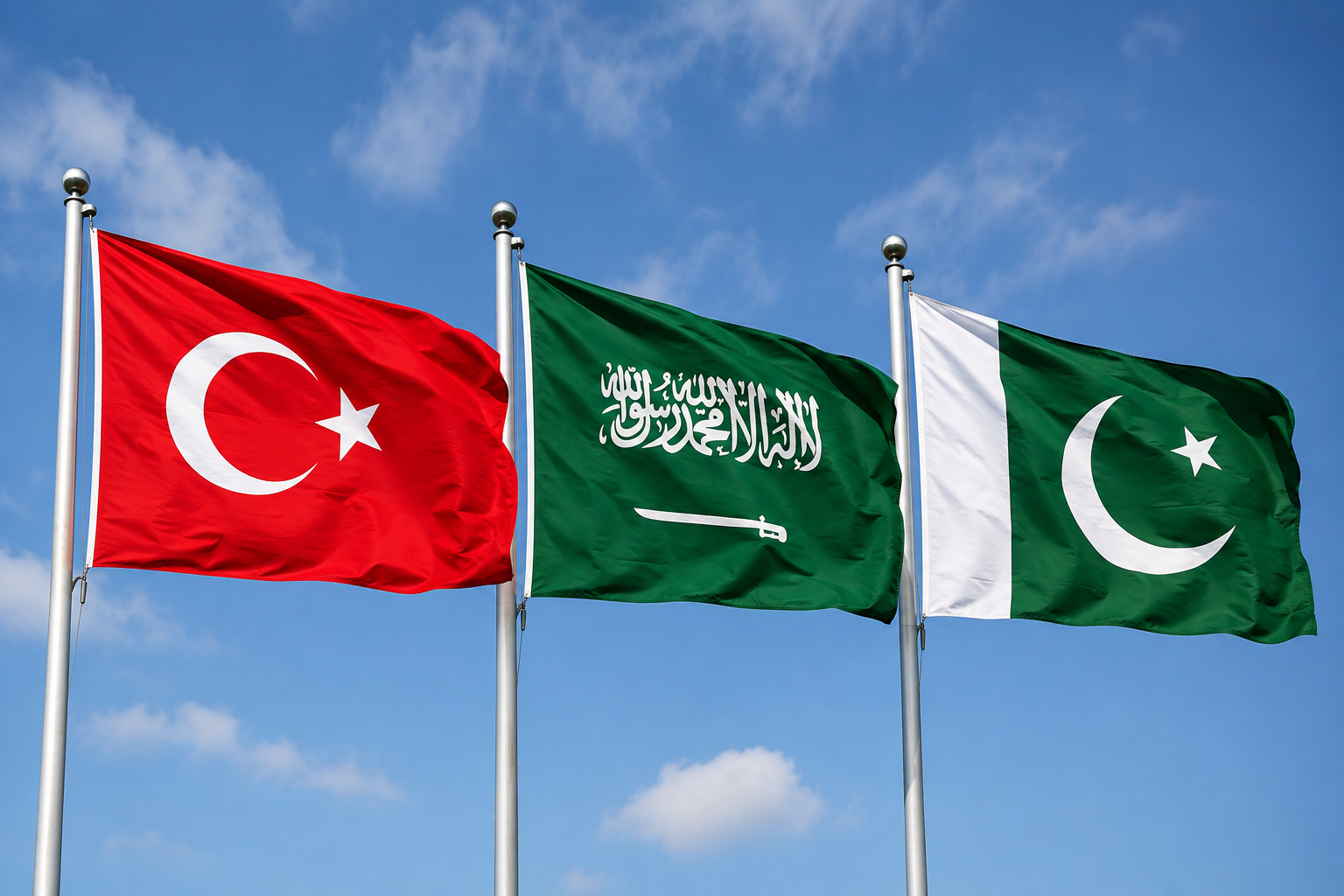
Türkiye - Saudi Arabia - Pakistan security axis: Toward new regional order? - OPINION
By Aytan Aliyeva
From Trilateral defence cooperation to strategic autonomy
The emerging defence partnership between Türkiye, Saudi Arabia and Pakistan should be understood within the broader transformation of the international and regional security order. Rather than simply representing another military agreement among three Muslim-majority states, the arrangement reflects a deeper attempt by important regional powers to increase their strategic autonomy in an environment characterized by declining predictability, shifting alliances and growing doubts about the durability of traditional security guarantees. The Middle East and its surrounding regions have historically been among the most unstable geopolitical environments in the world. The wars in Iraq and Syria, tensions between Iran and its regional competitors, the Israeli-Palestinian conflict, instability in Yemen, rivalry in the Eastern Mediterranean, competition between India and Pakistan and the increasing involvement of China and Russia have produced a highly fluid strategic landscape. In this context, Türkiye, Saudi Arabia and Pakistan have strong incentives to establish mechanisms that reduce their vulnerability to sudden geopolitical changes.
The significance of the partnership derives primarily from the complementary strategic characteristics of its three core participants. Türkiye possesses one of the region's strongest conventional militaries and has developed an defence-industrial base. Turkish companies have expanded their capabilities in unmanned aerial vehicles, missiles, electronic warfare, naval platforms, armoured vehicles and aerospace technologies. Türkiye also possesses operational experience and remains a member of NATO, giving its military decades of experience with Western doctrines, command structures and interoperability. Ankara therefore brings technological, industrial and conventional military capacity to the emerging partnership.
Saudi Arabia contributes a different form of power. Its central strengths are financial resources, energy influence, geographic position and political weight in the Arab and Islamic worlds. Riyadh has historically relied heavily on the United States for advanced military equipment and external security guarantees. However, changes in American priorities and uncertainty regarding the extent of future US involvement in Middle Eastern security have encouraged Saudi Arabia to diversify its strategic relationships. Cooperation with Türkiye and Pakistan does not necessarily indicate that Riyadh intends to replace Washington. Instead, it provides strategic insurance by ensuring that Saudi security is not dependent on a single external partner.
Pakistan supplies the third component. It has one of the largest and most experienced armed forces in the Muslim world and, most importantly, is a nuclear-armed state. Islamabad's principal strategic concern remains India, but Pakistan has maintained deep military relations with Saudi Arabia for decades and increasingly close defence-industrial cooperation with Türkiye. Participation in a wider security framework allows Pakistan to convert military capability into diplomatic and economic influence. Saudi investment and financial assistance can alleviate some of Pakistan's economic constraints, while Turkish technology can contribute to military modernization. Pakistan offers manpower, military training, strategic depth and a degree of nuclear ambiguity that inevitably affects the calculations of potential adversaries.
The basic geopolitical equation can therefore be summarized as Saudi financial power, Turkish technological and conventional military capability and Pakistani manpower and strategic deterrence. This complementarity makes the arrangement potentially more durable than alliances based on ideological solidarity. Each participant gains something tangible that it cannot easily generate independently.
The strategic calculations of Türkiye, Saudi Arabia and Pakistan
For Türkiye, the partnership fits Ankara's wider ambition to become an independent geopolitical centre connecting Europe, the Middle East, the Caucasus, Central Asia and the Indian Ocean. Türkiye's position within NATO remains important, but Ankara has repeatedly demonstrated that alliance membership does not prevent it from pursuing an autonomous regional strategy. Its policies in Syria, Libya, the South Caucasus, Africa and the Eastern Mediterranean, together with the rapid expansion of its defence industry, indicate an ambition to transform Türkiye from a regional military power into a broader geopolitical actor.
The partnership with Saudi Arabia and Pakistan advances this objective in several ways. Saudi Arabia provides capital and access to the Gulf defence market, while Pakistan provides a large military partner and a geographical bridge toward South Asia. Türkiye can potentially become the technological and defence-industrial centre of the arrangement. Joint production of drones, missiles, aircraft, naval systems and electronic-warfare technologies would give Ankara economic benefits while increasing the dependence of participating countries on Turkish defence infrastructure. Türkiye also gains geographic reach. A security network connecting Türkiye with Saudi Arabia and Pakistan potentially stretches from the Eastern Mediterranean through the Middle East and Gulf to the Arabian Sea. If Azerbaijan, Syria, Jordan or Qatar eventually become participants, Türkiye would sit near the geographical centre of security corridor. Such an arrangement would strengthen Ankara's ability to influence developments well beyond its immediate borders.
Saudi Arabia approaches the partnership from a different perspective. Riyadh possesses enormous financial resources but has historically faced a structural imbalance between economic power and indigenous military capacity. Despite massive defence expenditures, Saudi Arabia has depended on foreign technology, training, intelligence and logistical support. Cooperation with Türkiye and Pakistan provides an opportunity to reduce this vulnerability. Türkiye offers advanced defence-industrial capabilities, while Pakistan offers military personnel, training and strategic depth. Pakistan's nuclear status inevitably adds another dimension. There is no basis for concluding that Pakistan's nuclear arsenal constitutes a formal Saudi nuclear umbrella. Nevertheless, strategic ambiguity itself can have deterrent value. Any state contemplating an existential confrontation with Saudi Arabia would have to consider the possibility that Riyadh's relationship with nuclear-armed Pakistan could acquire greater strategic significance during an extreme crisis. Saudi Arabia, therefore, gains an additional layer of uncertainty in the calculations of potential adversaries without developing its own nuclear weapons.
For Pakistan, the partnership potentially represents the largest relative geopolitical upgrade. Pakistan possesses substantial military capabilities but faces persistent economic constraints and a significant power imbalance with India. Embedding itself within a broader security network allows Islamabad to convert military strength into economic and diplomatic capital. Saudi investment, Gulf economic opportunities and Turkish technology could strengthen Pakistan's position, while Islamabad becomes increasingly valuable as a security provider rather than being viewed primarily through the prism of its rivalry with India. This does not mean that Saudi Arabia or Türkiye would intervene in an India-Pakistan conflict. Saudi Arabia has important relations with New Delhi and would have powerful reasons to avoid direct involvement. Nevertheless, Pakistan's participation in a wider security structure complicates Indian strategic calculations and gives Islamabad additional diplomatic leverage. Pakistan can also position itself as the eastern anchor of a security system extending from Anatolia through the Gulf into South Asia.
The three countries therefore approach the partnership from different starting points, but their interests converge around a common objective: maximizing national power without becoming completely dependent on any single great power. Türkiye converts technology into geopolitical influence; Saudi Arabia converts financial resources into strategic insurance; and Pakistan converts military capability into economic support and diplomatic relevance.
Potential expansion
The long-term importance of the arrangement will depend considerably on whether it remains trilateral or develops into a broader regional security order. Several countries are partners or potential future participants, but their strategic importance and willingness to accept collective-defence commitments differ significantly. Egypt, Qatar, Azerbaijan, Jordan, Syria and the other members of the Gulf Cooperation Council represent important possibilities.
Egypt would arguably be the most consequential addition. Its participation would fundamentally change the political and geographic character of the organization. Egypt is the most populous major Arab state, possesses one of the region's largest armed forces and controls the Suez Canal, one of the world's most important maritime chokepoints. Geographically, Egypt connects the Mediterranean, Red Sea, Middle East and Africa. An arrangement bringing together Türkiye, Saudi Arabia, Pakistan and Egypt would therefore possess significantly greater strategic weight and Arab legitimacy. Cairo has traditionally guarded its strategic independence and would be reluctant to enter an organization perceived as being dominated by Ankara or Riyadh. Egypt and Türkiye have also experienced serious political disagreements during the previous decade, despite their more recent normalization. Consequently, Egypt may initially prefer structured military cooperation, exercises and intelligence coordination rather than accepting an automatic collective-defence obligation. Nevertheless, if Cairo entered the core framework, it would represent one of the clearest indicators that the organization had developed beyond a limited trilateral pact.
Qatar presents a more straightforward case. Doha maintains particularly close security relations with Türkiye, including an established Turkish military presence, while maintaining an extremely important defence relationship with the United States. Qatar also has good relations with Pakistan and has restored relations with Saudi Arabia following the intra-Gulf crisis of 2017-2021. Qatar could therefore serve as a bridge between Türkiye, Saudi Arabia and the existing American security architecture. Its participation would add substantial financial and energy resources without necessarily transforming the arrangement into an anti-Western bloc.
Azerbaijan is another strategically logical candidate, especially from Türkiye's perspective. Ankara and Baku have developed a close political and military relationship, strengthened by Azerbaijan's military successes in the South Caucasus region and Turkish-Azerbaijani defence cooperation. Azerbaijan would extend the geographic reach of the emerging framework into the Caucasus and Caspian region. It would also contribute energy resources and recent combat experience. However, Azerbaijani participation would create sensitivities involving Iran and Russia. A security network linking Azerbaijan, Turkey, the Arab states and Pakistan could be interpreted in Tehran as a partial encirclement of Iran.
Jordan would be valuable for different reasons. Although its military is much smaller than those of Türkiye, Pakistan or Egypt, Jordan possesses professional armed forces, intelligence services and experience in regional security cooperation. Its geography is especially important. Jordan lies between Syria, Saudi Arabia, Iraq, Israel and the Palestinian territories. Jordanian participation could therefore help connect the Gulf security environment. At the same time, Amman's close dependence on Western economic and security assistance means that it would probably avoid arrangements perceived as directly challenging the United States.
Syria is potentially important in the longer term because of geography rather than current military strength. A stable Syria aligned with Türkiye and the Arab states could provide territorial continuity between Anatolia and the Arabian Peninsula. A Türkiye-Syria-Jordan-Saudi corridor would transform the strategic geography of the alliance by creating a relatively continuous north-south security space. Yet Syria's internal reconstruction, institutional weakness and military restructuring make full membership considerably more complicated in the short term.
The Gulf Cooperation Council (GCC) presents another possibility, but the GCC should not be treated as a single strategic actor. Saudi Arabia is already at the centre of the arrangement, while Qatar could integrate relatively easily. Bahrain and Kuwait might participate if the organization complemented rather than replaced existing Gulf and American security mechanisms. The United Arab Emirates would bring financial resources, technological capabilities, ports and logistical networks but would probably insist on maintaining considerable strategic autonomy. Oman would be the most difficult case because its foreign policy has traditionally emphasized neutrality, mediation and balanced relations with Iran.
A successful expansion strategy would probably require a layered rather than uniform architecture. Türkiye, Saudi Arabia and Pakistan could constitute the core collective-defence triangle. Egypt, Qatar, Azerbaijan and Jordan could form a second layer of close defence partners or eventual members. Other GCC countries could participate through intelligence sharing, maritime security, air and missile defence and joint exercises without accepting identical treaty commitments. Syria could enter as its internal situation stabilizes.
Prospects for success and the emergence of a New Regional Security Order
The central question is whether this developing structure can survive the very characteristic that makes it necessary: the extraordinary volatility of the region. Türkiye, Saudi Arabia and Pakistan do not share identical threat perceptions. Pakistan's security establishment remains concerned with India and developments in Afghanistan. Saudi Arabia concentrates on Gulf security, Iran, missile and drone threats, Yemen and the broader balance of power in the Middle East. Turkey's priorities include Syria, Kurdish armed organizations, the Eastern Mediterranean, the Caucasus, the Black Sea and its complex relationships with Russia, Iran, Israel, Europe and the United States. Potential future members would introduce still more diverse interests.
This divergence is the principal obstacle to transforming the arrangement into a comprehensive collective-defence alliance. The decisive test will not occur when the members conduct exercises together or issue declarations of solidarity. It will occur when one member enters a confrontation that the others do not regard as directly affecting their national security.
The difficult and constantly changing geopolitical environment may also provide the strongest incentive for cooperation. Regional governments increasingly understand that fixed alliances with external great powers cannot address every security challenge. Washington remains militarily dominant, but American priorities can change between administrations. China has become economically indispensable to many regional states but remains cautious about assuming extensive military obligations. Russia has demonstrated its ability to intervene regionally but lacks the economic resources to become a comprehensive security guarantor. Consequently, regional middle powers have strong incentives to construct their own supplementary security arrangements.
The most pragmatic outcome would be a regional security network rather than a “Muslim NATO”. Different from NATO, the forming alliance lacks an integrated command structure and permanent military institutions. Therefore, its development will depend on practical cooperation in areas such as intelligence sharing, joint exercises, missile and air defence, and maritime security, particularly defence-industrial cooperation. The alliance's main strength lies in the complementary capabilities of its members: Türkiye could provide military technology and industrial capacity, Saudi Arabia could provide financial and political power, and Pakistan could provide military depth and nuclear deterrence. Egypt, Qatar, Azerbaijan and Jordan could further expand its military, financial and geographical reach, and Syria and other GCC states could participate over time. Such a structure could support multi-alignment rather than confrontation with existing powers. Members could maintain their relationships with the United States, China and other partners while reducing their dependence on a single external security provider. Success depends more on developing institutions and military cooperation than on numbers. If successful, it could become a significant Anatolian–Arab–South Asian security structure in a multipolar international system.
Photo AI