Slovakia identifies key reforms for Moldova’s EU accession - EXCLUSIVE
The Slovak Republic has reaffirmed its strong support for the European integration aspirations of the Republic of Moldova, emphasizing that continued reforms in the rule of law, judicial sector, and anti-corruption efforts will be crucial to ensuring a smooth and credible accession process to the European Union.
This was said by the source in the Ministry of Foreign and European Affairs of the Slovak Republic, in an exclusive interview with CE Report.
According to the ministry, Moldova has already achieved significant progress in its EU enlargement journey, particularly through the ongoing process of opening the first accession cluster, “Fundamentals.” Slovakia described this development as an important milestone that demonstrates both the credibility and momentum of Moldova’s accession process, while expressing support for the opening of additional negotiation clusters in the near future.
Drawing from its own experience of joining the European Union in 2004, Slovakia stressed that strengthening the rule of law, carrying out comprehensive judicial reforms, and maintaining a sustained fight against corruption remain among the most important priorities for candidate countries. The ministry noted that these reforms are essential not only for meeting EU requirements but also for ensuring public confidence in the accession process.
At the same time, Slovak officials highlighted the importance of aligning Moldova’s national legislation with the EU acquis, particularly in areas related to the internal market and economic reform. Such efforts, they said, are vital for Moldova’s gradual integration into the European legal and economic space.
The ministry reiterated that Slovakia remains a long-standing supporter of EU enlargement, including for Moldova, Ukraine, and the Western Balkan countries, arguing that enlargement contributes to a stronger and more competitive European Union.
Beyond political support, Slovakia is actively involved in helping Moldova advance its reform agenda through a wide range of bilateral and European cooperation initiatives. The ministry explained that bilateral engagement is based on three main pillars: support for Moldova’s EU integration and accession process, implementation of SlovakAid and development cooperation programmes, and support for Moldova’s sovereignty, independence, and resilience.
Moldova has also been designated as a priority partner country under Slovakia’s Medium-Term Development Cooperation Strategy for 2025–2030.
As part of this cooperation, Slovakia is contributing expertise through several major projects. These include a Twinning project on labour safety and social dialogue implemented jointly with Spain, a forthcoming EU Delegated Project on access to the EU Single Market in cooperation with France and the Czech Republic, and a Twinning project in public financial management and audit led by Slovakia together with experts from Germany, Latvia, and Lithuania.
The ministry also pointed to ongoing support through SlovakAid programmes and regional mechanisms such as the International Visegrad Fund, which facilitate cooperation in academia, public administration, and civil society.
Looking ahead, Slovakia sees significant potential for expanding technical assistance, investment partnerships, and economic cooperation with Moldova. Officials noted that bilateral trade and investment relations are developing dynamically, supported by cooperation between investment and trade promotion agencies, chambers of commerce, and other institutions from both countries.
According to the ministry, considerable untapped opportunities remain in joint investment, industrial projects, and technological cooperation. Slovakia and Moldova are therefore committed to encouraging stronger private-sector engagement and creating favourable conditions for future economic partnerships.
The Slovak Republic concluded that continued reform implementation remains the primary driver of Moldova’s progress in accession negotiations and reaffirmed its commitment to supporting Moldova on its European path.
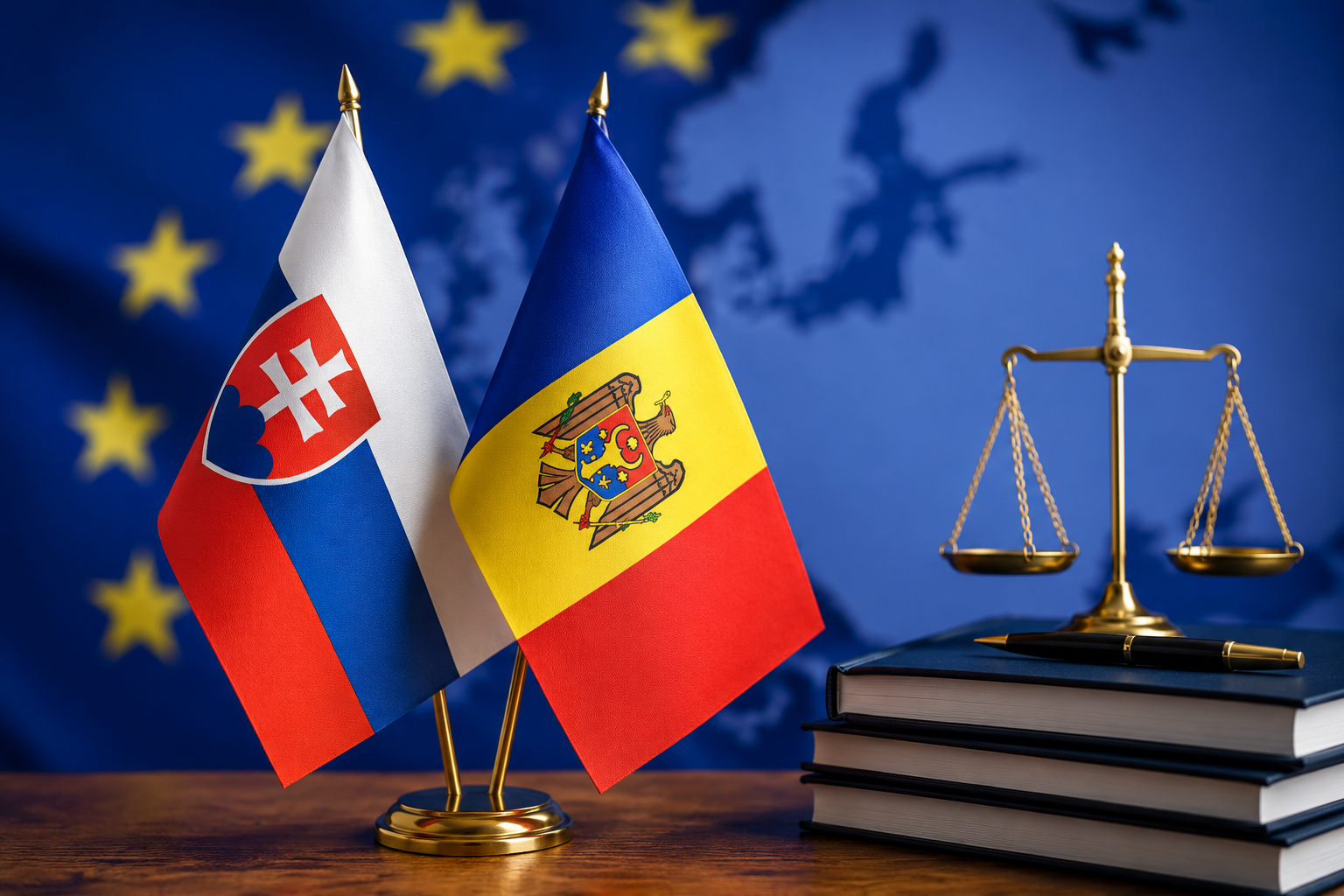
Photo: Chat GPT
This interview was prepared by Laura Hoffman