Italy bridges ancient and contemporary art in new exhibitions
Memling alongside the Baroque, then Escher, Jan Fabre and Elisabetta Catalano: these are some of the leading figures featured in exhibitions opening this week, spanning ancient and contemporary art, CE Report quotes ANSA.
PADUA – The tessellations, metamorphoses, optical illusions, reflective surfaces and geometric paradoxes that made the works of one of the most original artists in art history famous are at the heart of the exhibition “M.C. Escher. All the Masterpieces,” running at the Centro Altinate – San Gaetano until July 19. Organized by Arthemisia, the show offers a comprehensive journey dedicated to the Dutch genius M. C. Escher, from his early years to his travels in Italy and the Mediterranean, exploring the various techniques he experimented with throughout his life.
FORLÌ-CESENA – A journey through the ideas and images that shaped the Baroque, highlighting the relationship between art, power, faith, science and society: this is the exhibition “Baroque. The Grand Theater of Ideas,” at the Museo Civico San Domenico from February 21 to June 28. The exhibition features over 200 works, including comparisons ranging from Hellenistic representations to the restless spatiality of late Mannerism and the extreme realism of Caravaggio, as well as the 20th-century reassessment of the movement.
BARI – At the Pinacoteca Metropolitana Corrado Giaquinto, from February 21 to April 21, the exhibition by Pamela Diamante, “The Invisible. Radical Existences,” curated by Roberto Lacarbonara, is on display. The artistic research and production project, dedicated to female agricultural laborers, stems from the anthropological and linguistic condition linking rural life, exploitation and the symbolic construction of social inferiority.
For the occasion, the artist has created an environmental installation resembling a mechanical device: sixteen vertical iron rods (matching the number of workers involved and twice their actual height) support metal discs and ceramic hoes, evoking agricultural machinery and tools used daily by the workers. This formal choice underscores the paradoxical hybridization of exploited bodies, reduced to cogs in an economic system that consumes their vital energy.
CARRARA – The art of Mikayel Ohanjanyan is featured until August 30 at the MudaC Museo delle Arti di Carrara with the solo show “Mikayel Ohanjanyan. Legami: Ties That Bind,” curated by Christopher Atamian and Tamar Hovsepian. Through five marble sculptures conceived as a single monumental installation, the exhibition reflects on the human condition and the invisible structures that hold everything together: individuals among themselves and the forces of nature, time and history.
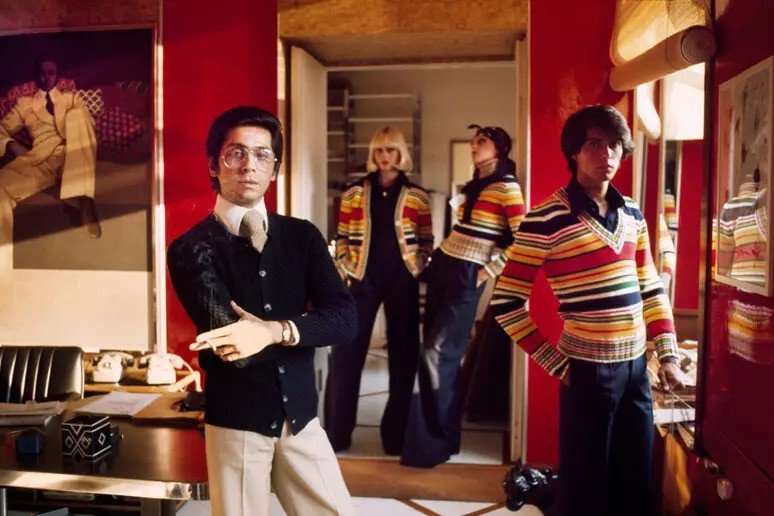
MILAN – Until April 19, Viasaterna hosts “Elisabetta Catalano. Cinema, Fashion and Performance,” a solo exhibition curated by Laura Cherubini in collaboration with the Archivio Elisabetta Catalano, in memory of Aldo Ponis. The exhibition documents the multifaceted art of the renowned photographer Elisabetta Catalano, known for her extensive portraits of artists, actors, designers and cultural figures, as well as for documenting performances by artists such as Jannis Kounellis, Joseph Beuys and Fabio Mauri.
The Museo Diocesano di Milano, on the occasion of Lent and Easter, hosts from February 19 to May 17 the “Crucifixion” by Hans Memling, dated around 1467–1470. The work, from the Museo Civico di Palazzo Chiericati in Vicenza, is the centerpiece of the exhibition “Hans Memling. The Crucifixion. Four Contemporary Artists Around a Masterpiece,” curated by Valeria Cafà, Giuseppe Frangi and Nadia Righi. The project is based on a dialogue between Memling’s work and those of Stefano Arienti, Matteo Fato, Julia Krahn and Danilo Sciorilli.
CORTINA D’AMPEZZO – Mucciaccia Gallery hosts the exhibition “Brain Thinking Models and Drawings by Jan Fabre.” The show presents the creative universe of the artist, whose research focuses on the relationship between art and science, imagination and method, through 25 works (11 drawings and 14 sculptures), placing drawing at the center as a primary tool of thought, experimentation and knowledge.