Bosnian fashion brand wins New European Bauhaus Prizes 2025
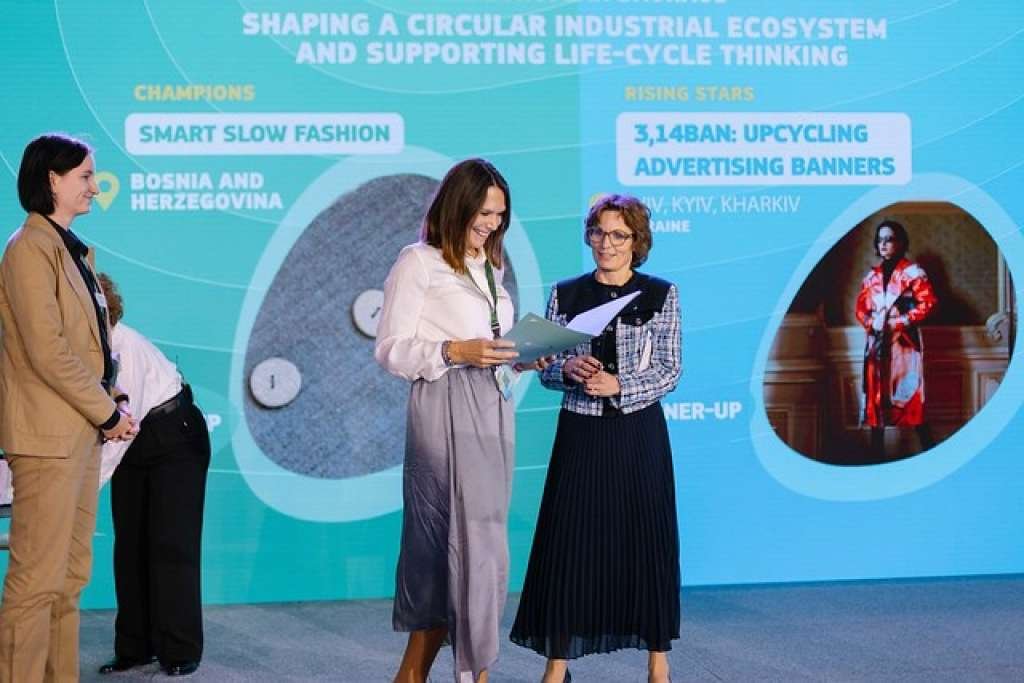
The Bosnian fashion brand Magbago, founded by Tamara Đurić from Bijeljina, won second place at the prestigious New European Bauhaus Prizes 2025 in Brussels. The recognition was granted in one of four thematic categories – “Shaping a circular industrial ecosystem and supporting life-cycle thinking.”
The New European Bauhaus Prizes are presented by the European Commission to projects and ideas that integrate the values of sustainability, inclusivity and aesthetics, CE Report quotes FENA.
In an interview with FENA, Đurić said they are proud of the award, emphasizing that the competition was extremely strong. More than 750 projects from across Europe were submitted, and Magbago managed to enter the group of 44 finalists and eventually finish among the 22 winners. The selection process was detailed, with each application going through several complex evaluation stages.
“For us at Magbago, this award has special meaning because our philosophy and practice fully reflect the principles of this category. Through the use of innovative fabrics made from plant waste, zero-waste principles, sustainable production and digital labels, we strive to ensure that each piece of clothing has minimal impact on the planet and maximum impact on quality of life. Receiving an award in this category means that Magbago is not just a slow-fashion brand, but also an example of an innovative approach to the circular economy in the fashion industry, where creativity and aesthetics merge with sustainability and responsible business practices,” said Magbago founder Tamara Đurić.
Speaking about the origins of the brand, Đurić said she faced health problems due to Atopic dermatitis and recurring eczema, which affected her quality of life.
“I started paying attention to the materials I wore because I noticed that synthetic fabrics further irritated my skin. I began researching natural and innovative materials that are gentler on the skin but also better for the environment. Since I have always loved fashion and drawing, that search gradually turned into the idea of launching my own brand that would offer a healthier and more sustainable alternative,” she said.
The name Magbago comes from the Filipino language and means change.
“We deliberately chose that word because a large part of fast-fashion production takes place in countries of South and Southeast Asia. Through the name itself we wanted to symbolically point to the need for change in the fashion industry – towards fairer, healthier and more sustainable production,” Đurić explained.
She noted that Magbago is a slow-fashion brand, meaning they create clothing that is durable, carefully designed and produced in small series.
Their work follows zero-waste principles, aiming to maximize material use and reduce waste. They also use digital labels – smart NFC tags – which replace traditional labels and provide transparency about the origin and composition of the product.
Speaking about production, Đurić said they do not manufacture the fabrics themselves because Bosnia and Herzegovina currently lacks the technological and industrial infrastructure for such production.
“Most of the fabrics we use are imported, but at the same time we are working on innovations and the development of biomaterials from waste in cooperation with the academic community in Bosnia and Herzegovina. We are also exploring the possibility of developing fabric from the cellulose of a plant that grows as a weed here. We are currently in the laboratory research and initial testing phase. If we succeed in developing a quality prototype, further development and production would have to continue in research institutes in Western Europe and the United States that have the necessary methods and conditions for industrial production,” Đurić said.
Regarding the process of producing fabrics from plant residues and waste, she explained that it varies depending on the type of material.
“For example, fabrics made from orange, banana, lotus or rose residues are created from by-products of the food or perfume industries. Orange peels are dried and ground into pulp, from which cellulose fibers are chemically extracted with the addition of biopolymers or natural binders that give the fibers stability. They are then spun into yarn and woven into a light, silky fabric. A similar principle applies to banana, lotus and rose fibers. The fibers are boiled, fermented or manually extracted, sometimes using natural binders, and then spun and woven into fabric. The result is environmentally friendly, luxurious and natural textiles that are gentle on the skin while demonstrating how plant waste can be transformed into high-quality materials,” she said.
For the founder of Magbago, fashion is not just what we see or wear outwardly.
“For me, fashion is a personal attitude, a belief and a way we present ourselves to the world. Fashion should not be perceived merely as a trend – it is much more than momentary popular styles. It is connected to our inner state and our essence. Through clothing we express identity, values and how we want others to perceive us. When we talk about sustainable fashion, it means that style and identity should not come at the expense of human health or the planet,” Đurić said.
Sustainable fashion, to which she is committed through the Magbago brand, implies a conscious choice of materials and production processes that respect the environment, reduce waste and support ethical manufacturing.
“Sustainable fashion is a philosophy – it reminds us that our aesthetic and creative decisions can have a broader impact, and that through fashion we can be authentic, aware and responsible towards the world around us,” she added.
In addition to special fabrics such as Orange fiber (made from orange peel residues), banana fiber (from banana stems), milk fiber (protein fiber derived from milk proteins) and soy fiber, the brand is also unique because it uses buttons made from eggshells instead of plastic. Traditional labels have been replaced by smart digital NFC tags.
Speaking about the market, Đurić said their focus is not on mass buyers but on health- and environmentally conscious women who value comfort, quality and sustainability.
“Our market is currently primarily Europe, with presence in Bosnia and Herzegovina and countries of the region where Magbago started and developed. In the future we aim to further expand our presence in the EU and Scandinavia through marketplace platforms that support independent and sustainable brands, as well as through cooperation with concept stores in Europe where our products and collections will be available to customers,” she said.
Magbago was founded in 2021 and, like most brands at the beginning, went through its early challenges while experimenting with different approaches and adapting to the market.
However, in Bosnia and Herzegovina the sustainable fashion market is still underdeveloped.
“Unfortunately, price often dictates purchasing decisions, and society still tends to value a certain logo more than the real quality of clothing and craftsmanship. That is why our work with Magbago has additional significance. We try to educate customers and show that sustainable and high-quality clothing can be aesthetically attractive, comfortable and durable, and that the choice between fast fashion and slow fashion is not just a matter of price but also of the value a garment carries for the skin, the environment and lifestyle,” she said.
Magbago produces small series, and the entire production takes place in Bosnia and Herzegovina in cooperation with Sugar on Top d.o.o. Vogošća, a small Sarajevo-based company also committed to sustainability and developing its own fashion brand.
When people learn what the fabrics are made of, they are often surprised and sometimes skeptical.
“There were even cases when people smelled the fabrics expecting to detect the scent of orange or other plants. However, fabrics do not retain the smell of fruit or flowers because it disappears during industrial processing. They also do not retain vitamins or minerals from the fruit, but they do preserve the natural properties of the fibers – meaning they are naturally hypoallergenic, light, breathable and comfortable for the skin,” Đurić said.
Speaking about the fashion industry as a major environmental polluter, she noted that fast fashion creates enormous amounts of waste, but there are no official data for Bosnia and Herzegovina.
“Not only here but across the region there is no policy for textile waste management – we do not have recycling centers, and awareness of recycling and sustainable purchasing habits is low. The problem is further complicated by wastewater treatment. Only a few cities in Bosnia and Herzegovina have proper wastewater treatment plants, although EU regulations require every settlement with more than 1,000 residents to have such systems. Because of this we do not know how much microplastic, toxic dyes and chemicals from washing clothes or textile processing end up in our water streams,” she said.
She added that the damage is also visible in the soil. For example, a garment made from synthetic materials can take several hundred years to decompose, meaning it accumulates in nature and disrupts ecosystems for a long time.
Textile waste also ends up directly in rivers, while poorly managed landfills mean that even sorted waste usually ends up in the same dump.
Magbago seeks a different approach to fashion. The brand produces small series from natural and innovative materials that are biodegradable and not mixed with synthetic fibers, making them suitable for recycling.
From the initial idea to the final product, the brand considers the end of the product’s life cycle, following zero-waste and circular economy principles. Coconut buttons and recycled paper packaging are used, while natural fabrics such as silk or recycled cotton are used for product presentation.
Magbago has received numerous awards and recognitions. Among them, the brand was a finalist for the Sustainable Development Business Leaders Award in the categories “Resources and Environment” and “People”.
This prestigious award is part of the SDG2BiH, funded by Sweden and implemented by UNDP in partnership with UNICEF and UN Women, with the support of the Foreign Trade Chamber of Bosnia and Herzegovina.
The brand also received special recognition at the Circular Economy Awards 2025 by the Western Balkans Circular Economy Hub, as well as the Made in BiH award for the development of new products.