Bank of Albania on inflation outlook for early 2026 - EXCLUSIVE
CE Report presents an exclusive interview given by a source in the Bank of Albania, shedding light on the recent trends in consumer price inflation, the factors behind its moderation in late 2025, and the central bank’s outlook for inflation in the coming months.
What were the key drivers behind the slowdown of consumer price inflation to an average of 2.2% in October-November 2025?
The moderation of consumer price inflation to 2.2% in the last two months was primarily driven by subdued – and in some cases negative – inflation dynamics in unprocessed food. Other price categories exhibited only limited changes, broadly maintaining their contribution to overall inflation. In particular, rent prices, which had accelerated since March, stabilized at around 6.7% during this period, thereby moderating upward pressures on inflation.
Accordingly, the easing of inflation in October – November mainly reflects the decline in short-term and imported inflation, supported by lower commodity prices in global markets and appreciation of the lek. On the other hand, core and domestic inflation continue to be the main drivers of headline inflation, contributing by 2.1 and 2.9 percentage points, respectively.
The slowdown in inflation during October-November 2025 was mainly driven by declining short-term and imported inflation. This was reflected in low - and sometimes negative – inflation of unprocessed food as well as goods and services with regulated prices. Rent price inflation also decreased slightly to 6.7% in November from 7% in the previous month, containing the upward effect mainly on core and domestic inflation. In addition, inflation in the categories of non-food industrial goods and some services sub-groups (hotels, restaurants and bars, education and transport) also slowed down. Despite the slowdown in inflation, core and domestic inflation remained the main contributors to total inflation (2.1 pp and 2.9 pp, respectively).
How does the Bank of Albania assess the sustainability of easing food price inflation and moderating rent growth in the coming months?
In our assessment, the unusually low food inflation observed over the past two years reflected not only the declining trend in global food commodity prices and Lek appreciation, but also the impact of temporary supply side shocks. Looking ahead, we expect food price inflation to follow a moderate upward trend. This outlook reflects: (i) global projections pointing to a slower decline in food commodity prices; (ii) a moderation in the pace of Lek appreciation; and (iii) the emergence of base effects as supply side shocks gradually fade.
As regards rent inflation, the recent stabilization suggests that no further increases are expected in the coming months. Nevertheless, some short-term volatility may persist associated with tourism activity.
To what extent did declining global oil prices contribute to the reduction of inflationary pressures during this period? (Oct-Nov 2025)
The decline in global oil prices over the past year had a direct impact on headline inflation of around -0.46 percentage points in 2023, -0.13 percentage points in 2024 and -0.10 percentage points in 2025. It has also helped contain production costs. Nevertheless, this disinflationary impact gradually diminished over the course of 2025, with the contribution of oil prices turning slightly positive in October and November, at around 0.03 percentage points.
Overall, while oil prices helped ease inflationary pressures earlier, in recent months they have instead exerted a mild upward contribution to headline inflation.
What external or domestic risks could potentially disrupt the current trend of weakening inflationary pressures?
In our assessment, the balance of risks to inflation is broadly neutral in the medium term. On the upside, inflation could exceed our expectations if global fragmentation or geopolitical tensions intensify driving higher commodity prices – particularly for oil and food – or if wage growth is stronger than anticipated, or its pass-through to prices is more pronounced.
How does the Bank of Albania evaluate the outlook for headline, core, and domestic inflation in early 2026?
Headline inflation is expected to converge to the target by mid-2026, supported by a gradual rise in imported inflation and the fading disinflationary impact of past supply-side shocks in food prices. This outlook reflects the anticipated stabilization of global prices and a moderation in the pace of lek appreciation, both of which are expected to ease disinflationary pressures from external sources.
At the same time, core and domestic inflation are projected to remain broadly in line with the inflation target, consistent with economic growth close to potential and anchored inflation expectations. This balance between external and domestic factors underpins the projection of a sustainable return of inflation to the target.
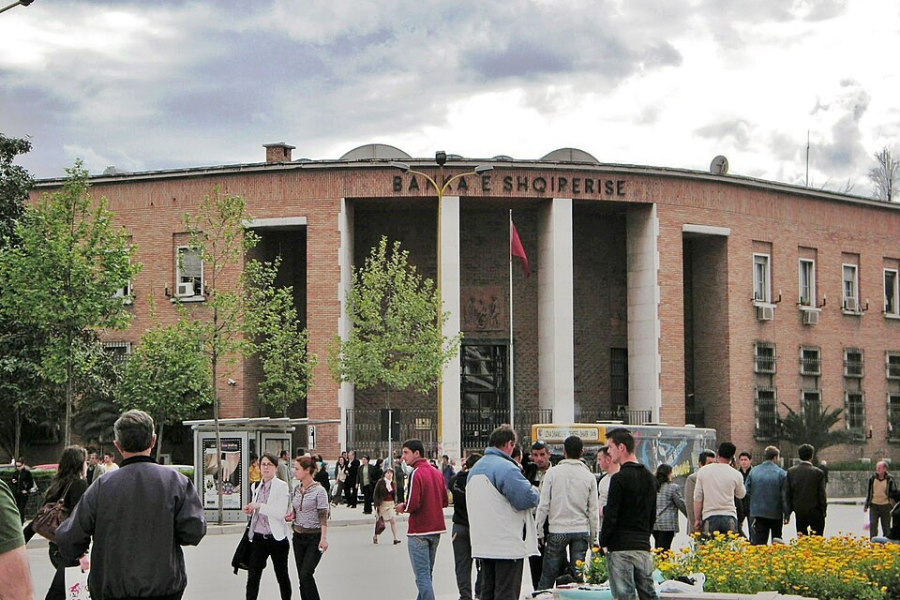
Photo: Wikipedia
This interview was prepared by Julian Müller