NASA's Voyager 1 becomes first human-made object to reach one light-day from Earth
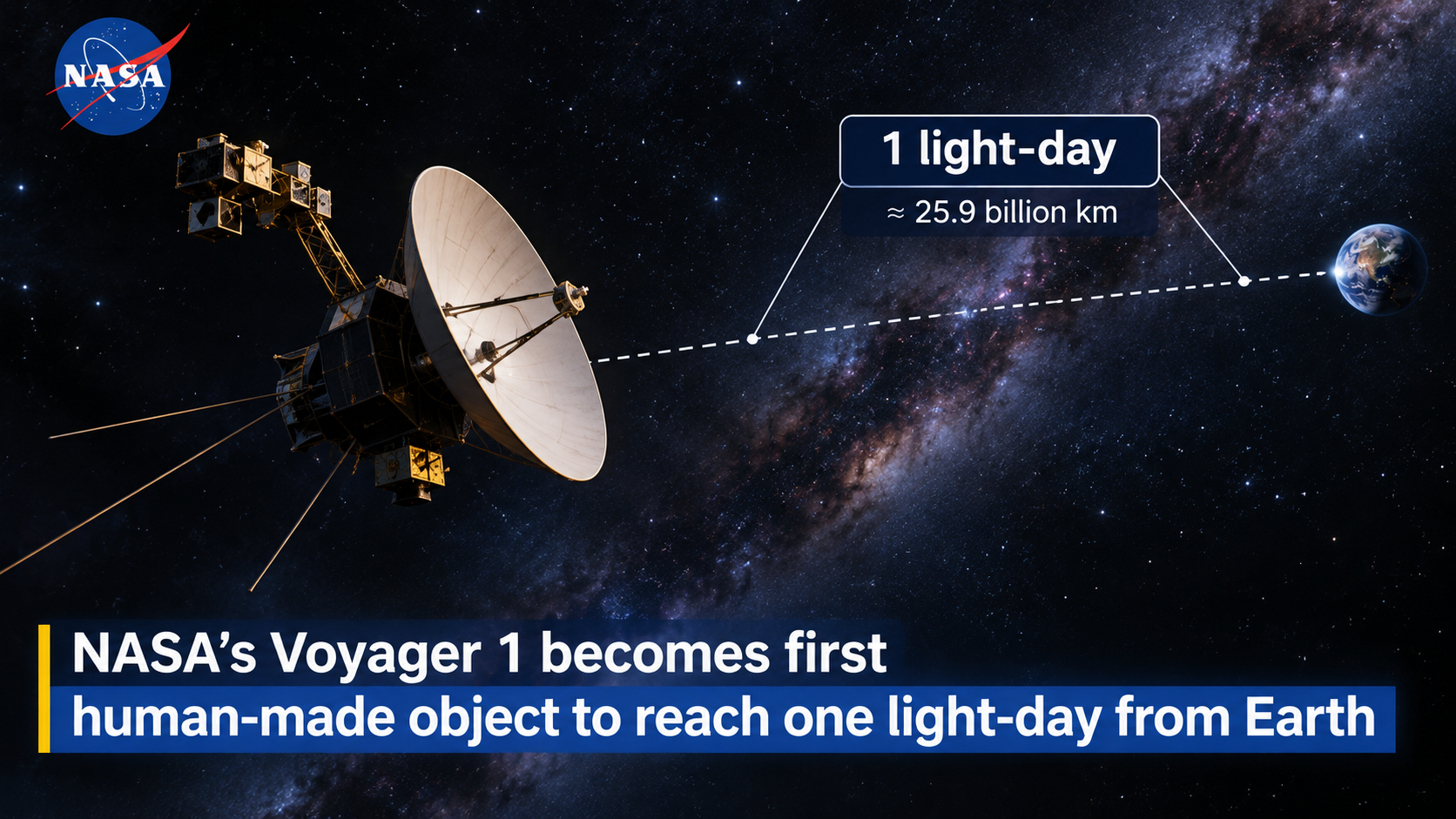
NASA's Voyager 1 spacecraft, launched into space in 1977, has become the first human-made object to reach a distance of one light-day from Earth.
In a statement posted on the US-based social media platform X, NASA announced:
"At 5:16 a.m. US Eastern Time on November 18, 2026, Voyager 1 reached a distance of one light-day from Earth."
After 49 years of travelling through space, Voyager 1 has now reached approximately 25.9 billion kilometres from Earth, marking another historic milestone in space exploration, CE Report quotes Anadolu Agency.
Radio signals take approximately 24 hours to travel one way between Earth and Voyager 1. This means that receiving a response to a command sent to the spacecraft takes approximately 48 hours.
As a result, engineers at NASA's Jet Propulsion Laboratory in California are expected to receive the first signal from the spacecraft on November 19.
A light-day is the distance that light travels in 24 hours, equivalent to approximately 25.9 billion kilometres.
Voyager 1's journey through space
Launched by NASA on September 5, 1977, Voyager 1 was originally designed to study Jupiter and Saturn.
The spacecraft flew past Jupiter in 1979 and Saturn in 1980, sending back important scientific data and images of both planets.
In August 2012, Voyager 1 crossed the outer boundary of the heliosphere, the region of space influenced by the Sun, and entered interstellar space.
Since 1998, Voyager 1 has held the distinction of being the most distant human-made spacecraft from Earth. It continues to transmit valuable scientific data about interstellar space back to our planet.
Photo: Chat GPT