Croatia proposes €41.5B budget for 2027, boosting defence, development spending
Croatia's 2027 state budget is focused on protecting citizens' living standards, continuing strong development investments and ensuring balanced regional development, while maintaining public finance stability, strengthening energy and food security, and investing in defence.
At the beginning of government session, dedicated entirely to the proposed 2027 state budget, Prime Minister Andrej Plenković explained that the meeting was being held on Saturday because, under the relevant regulations, the government is required to submit its budget proposal to Parliament by November 15 of the current year, CE Report informs via the Croatian government website.
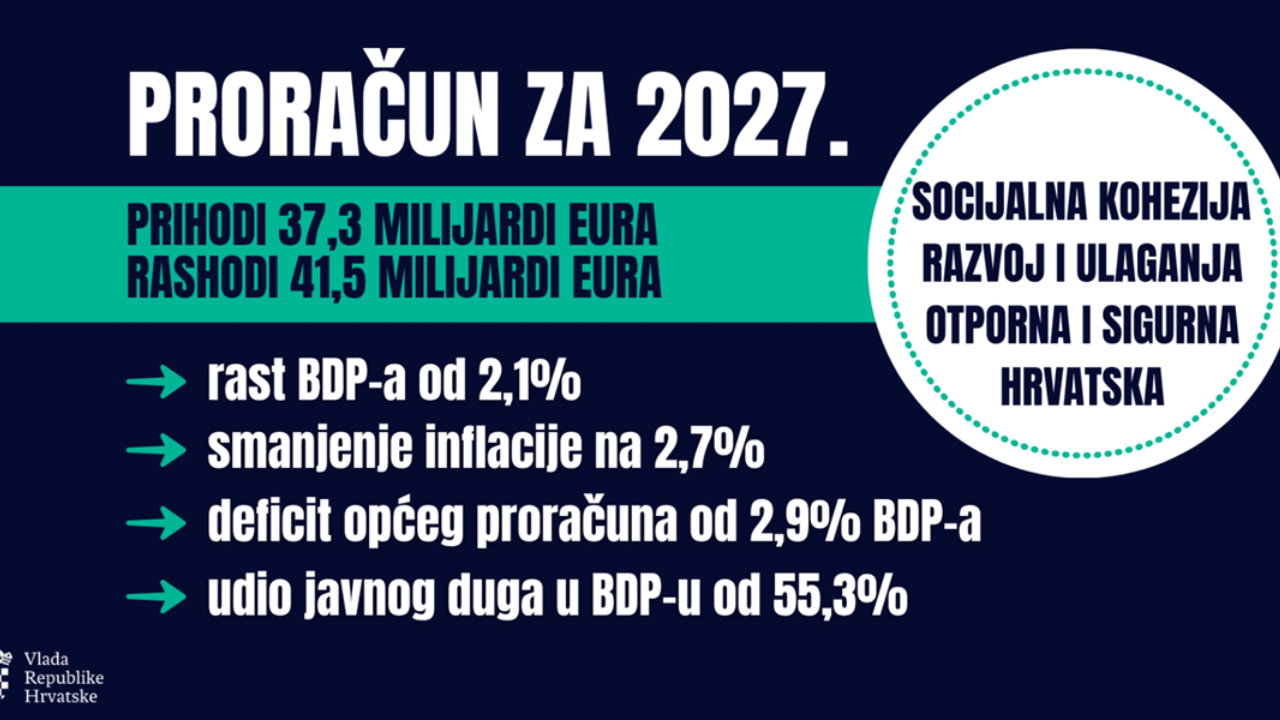
Earlier this week, the government adopted Croatia's Budgetary Plan, which provides an overview and projections of key macroeconomic and fiscal indicators for 2026. Plenković recalled that, according to the plan, GDP is expected to grow by 2.1% in 2027, 2.2% in 2028 and 2.1% in 2029, meaning that Croatia will continue to outperform the European Union and eurozone averages.
Inflation is expected to decline in 2027, reaching approximately 2.7% annually, a significant decrease compared with the projected rate for 2026. The general government deficit is expected to remain within 2.9% of GDP, while public debt as a share of GDP is projected to fall further to 55.3%.
Maintaining budgetary balance and social cohesion despite challenging geopolitical circumstances
In this way, Croatia continues to ensure a stable macroeconomic framework and budgetary balance despite the numerous difficult and challenging circumstances facing the country and the world, including conflicts, energy shocks and inflationary pressures, Prime Minister Plenković stressed.
Presenting the main budget figures, the prime minister said revenues would increase by 2% to €37.3 billion, while expenditure would rise by 2.2% to €41.5 billion.
As in previous years, he noted, the budget aims to preserve social cohesion and support the most vulnerable, particularly pensioners, while also prioritising family policy and demographic revitalisation.
When all allocations for demographic revitalisation are taken into account, funding for strengthening families as the foundation of Croatian society will exceed €1 billion for the first time this year, he added.
Investments in development and resilience
The budget continues the policy of balanced regional development, including further investments throughout Croatia in kindergartens, schools, hospitals, improved waste management, water and municipal infrastructure, as well as support for crafts, entrepreneurship and industry. It also promotes better transport, energy, digital and broader infrastructure connectivity across the country, the prime minister said.
Given the crises Croatia has faced, the budget also emphasises resilience, Plenković noted. It guarantees stable public finances and investments in energy, agriculture and fisheries to strengthen the country's energy and food security. Significant funding is also allocated to defence policy and internal security.
The government is also taking care of Croatian Homeland War veterans and supporting activities aimed at strengthening the judiciary and improving the effectiveness of the rule of law, he added.
Pension system stability and increases in pensions and social benefits
Almost €11 billion has been allocated to the pension system, €875 million more than this year.
"Our message to pensioners is that the pension system is stable and pensions will continue to increase, supported by an improved adjustment formula, an increase in the annual pension supplement and the abolition of income tax on pensions," the prime minister said.
The government will also continue implementing the Zaželi programme, which connects people facing greater difficulties in finding employment, particularly in rural areas, with services providing assistance to elderly and vulnerable people in their homes. Plenković described the programme as a Croatian innovation that has proven highly successful.
Personal assistance services for people with disabilities and the network of community-based social services are being expanded. Funding has also been secured for the inclusive allowance, which consolidates previously separate entitlements.
Construction of centres for older people will continue, alongside the introduction of a new respite care service, recognising that family members who have spent years caring for their relatives also deserve a break.
Affordable energy and housing
The government will continue maintaining capped electricity and gas prices to ensure that households remain protected during the winter, Plenković said, noting that these measures have significantly helped Croatian citizens and numerous other sectors of society overcome the energy crisis.
Affordable housing is another key priority, particularly for young people and families. Accordingly, €246 million has been allocated for implementing the National Housing Policy Plan in 2027. Under the affordable housing programme, construction of up to 1,000 apartments will begin in 16 cities and municipalities next year.
The prime minister also announced continued investments in student accommodation, scholarships and subsidised meals. He recalled that a meal in student restaurants across 25 Croatian cities costs €0.86.
Through the combined use of national and European funding, this budget enables continued investment in infrastructure and services for citizens and businesses, as well as balanced regional development, Plenković said.
Investments in reconstruction and transport infrastructure
In this context, he particularly highlighted continued reconstruction following the Zagreb and Petrinja earthquakes, with €5.3 billion invested in the process so far.
Regarding transport infrastructure, funding has been secured for completing the motorway and expressway networks throughout Croatia, modernising railways, purchasing new trains and vessels, and improving maritime and port infrastructure.
Croatia's economy must also address a key European objective: competitiveness, modernisation and the expansion of production capacities, innovation, research and development, the application of advanced technologies and the use of artificial intelligence. All these priorities are included in the National Industrial Development Plan, Plenković said.
Major healthcare and education infrastructure projects
Among the major healthcare projects, the prime minister highlighted the construction of the National Children's Hospital in Zagreb, for which €237 million has been allocated.
Construction and completion work is also underway on the new complex of the Dr Fran Mihaljević University Hospital for Infectious Diseases. The Dubrava Clinical Hospital is being renovated, while reconstruction of the Zagreb University Hospital Centre following the earthquake is nearing completion.
Preparations are underway for new hospitals in Osijek, Split and Šibenik, an emergency medicine centre in Slavonski Brod, a day hospital in Velika Gorica and seven new emergency medical facilities in Istria, he announced.
A total of €220 million is being allocated for the construction and equipping of primary schools, with the clear objective of ensuring that all children attend school in a single shift and benefit from full-day classes, the prime minister emphasised.
Another €163 million is being allocated to support kindergartens, while free textbooks, meals and transport for primary school pupils will continue, with €120 million allocated annually for these purposes.
Support for islands, local communities and Croatian sport
Programmes promoting balanced development will continue in Slavonia, Lika, the Dalmatian hinterland, Banovina, Gorski Kotar, mountainous and disadvantaged areas, as well as urban development projects. Croatian islands, their connectivity and the living and working conditions of their residents will remain an important priority, the prime minister said.
The government is introducing a new measure under which local communities will receive funding to provide housing and better living conditions for doctors, ensuring accessible healthcare on the islands. Island residents will also continue to pay the same water prices as people on the mainland, he stressed.
Funding for Croatian sport is being increased, reflecting its importance for healthier lifestyles and promoting Croatia internationally.
Major sports infrastructure projects are also planned, including completion of the Croatian Football Federation's training camp, projects of national importance such as Dinamo's Maksimir Stadium and Hajduk's Poljud Stadium, and a major investment in the Water Sports Centre in Zagreb.
The government has also found a solution for medical examinations for athletes under the age of 18, allocating €11 million in the budget. This will benefit as many as 145,000 athletes and their families, thereby fulfilling the government's programme, Plenković said.
Modernisation of the Croatian Armed Forces and strengthening national security
Speaking about resilience, the prime minister noted that the Ministry of Defence's budget would increase from €1.64 billion to €2.05 billion, bringing defence spending above 2% of GDP according to NATO criteria.
The modernisation of the Armed Forces will continue, with investments in Leopard tanks, HIMARS and Chunmoo rocket systems, unmanned aerial vehicles, a multipurpose vessel/corvette, upgrades to Rafale fighter capabilities and other equipment, he recalled.
Basic military training will continue, alongside the return of the Croatian Army to various parts of the country. In the coming period, the government aims to return the military presence to Beli Manastir.
Other priorities include the Croatian police, firefighting services, civil protection, helicopter rescue operations and stronger surveillance of the country's external borders. Significant funding for these activities will be provided under the new multiannual financial framework.
Addressing past injustices towards Croatian Homeland War veterans
Prime Minister Plenković highlighted efforts to reverse a number of previous decisions that had placed Croatian Homeland War veterans in a disadvantaged position.
In this context, he announced continued efforts to locate missing persons, noting that Croatia is still searching for 1,725 people who went missing during the Homeland War. A total of 343 people have been identified during the current government's terms in office, he added.
Veterans' centres in Pakrac and Slunj are nearing completion, while construction of new centres in Biograd na Moru, Krapina, Osijek, Senj and Virovitica is scheduled to begin in 2027. These projects follow the successful experience of centres in Daruvar, Petrinja, Šibenik and Sinj.
Activities will also begin to establish a public institution for victims of the Second World War and the post-war period in Macelj.
Energy and food security
Croatia is strengthening its gas and electricity infrastructure and expanding the capacity of the LNG terminal on the island of Krk. The government is also supporting the development of battery storage systems, public transport and geothermal energy for district heating, Plenković said.
Funding has been secured for agriculture and fisheries to increase production and support specific sectors in mitigating market disruptions and maintaining liquidity.
Resources have also been allocated for completing construction of the Justice Square complex in Črnomerec, implementing the regulatory framework for artificial intelligence, protecting children in the digital environment and further developing the e-Citizens platform.
Investments in culture and demographic revitalisation
Funding will continue for cultural vouchers for young people, the restoration of cultural heritage, investments in museums, archives and libraries, and the activities of national cultural institutions.
Regarding demographic revitalisation, the prime minister highlighted positive trends in the number of newborn children. In this context, he announced the continuation of full salary compensation during parental leave, increases in one-off benefits, tax relief for returning Croatian expatriates, as well as new measures such as the renovation of children's playgrounds and financial assistance for purchasing vehicles for families with four or more children.
Funding from both the state budget and European allocations has also been secured for all agricultural and fisheries priorities, with the aim of strengthening production, increasing self-sufficiency and food security, and implementing measures to protect animal health.
Water and municipal infrastructure projects and waste management
A total of €745 million has been allocated over the three-year period for water and municipal infrastructure projects, including investments in water supply networks, sewage systems and wastewater treatment, alongside €250 million for flood protection.
Another €200 million has been earmarked for waste management, including the rehabilitation of closed landfills, construction of waste management centres and facilities for energy recovery from waste, namely waste-to-energy plants.
Additionally, €43 million has been allocated for projects benefiting Croats living outside Croatia, the prime minister emphasised in his opening remarks.
Ćorić: Budget has a strong development and social focus
During the continuation of the session, Deputy Prime Minister and Finance Minister Tomislav Ćorić presented the proposed amendments to the decision on the budgetary framework for 2027–2029, the draft 2027 state budget and projections for 2028 and 2029, the draft financial plans for extrabudgetary users for 2027 and projections for 2028 and 2029, as well as the final draft law on the implementation of Croatia's 2027 state budget.
Ćorić said the proposed 2027 budget reflected the government's policies and had a strong development and social focus.
He thanked all government departments for their constructive cooperation in preparing the new budget.
"We believe that the macroeconomic results achieved by our country in 2027, particularly given the increasing focus on the productivity of our economy in the coming period, will be somewhat better. This should also give us an opportunity, when revising the budget at the end of 2027, to further improve some of the planned items presented here, particularly in terms of state budget revenues," Ćorić said.
Šušnjar: Improving the permanent system of price transparency and consumer protection
Economy Minister Ante Šušnjar presented proposals to repeal several decisions introducing direct price-control measures in retail trade, including requirements for publishing price lists, displaying additional prices and publishing lists of product and service prices.
He explained that these measures had been introduced to increase price transparency and improve consumer information, with the primary objective of helping to curb inflationary pressures.
The measures, he added, had been a response to specific market conditions at the time and the need for additional instruments enabling consumers to make informed purchasing decisions.
To further improve price transparency and establish a permanent system of consumer information and protection, regulations governing price displays have now been adopted under the Consumer Protection Act.
These include the Regulation on Displaying the Base Price of Products and the Regulation on the Method of Publishing Product Price Lists, both of which will enter into force on November 17, 2026.
The minister stressed that exceptional price-control measures were, by their legal nature, temporary and intended for use under specific market conditions, whereas the new regulations establish a permanent framework for price transparency and consumer protection.
Photo: Croatian government website