Hungary between Continuity and Political Change - OPINION
By Aytan Aliyeva
The transformation of the political system under Viktor Orbán's governance
Since returning to power in 2010, Viktor Orbán and his party Fidesz have transformed Hungary’s political system. This transformation did not occur through the abolition of democratic institutions, but rather through their systematic restructuring and gradual reconfiguration. The result is a system that formally preserves electoral competition and constitutional governance, yet operates in a manner increasingly described in political science as a hybrid regime or illiberal democracy - a term Orbán himself popularized in 2014.
At the core of this transformation lies the centralisation of political authority. Through the adoption of a new constitution in 2011 and numerous subsequent amendments, the executive has strengthened its position vis-à-vis other branches of government. Institutions traditionally designed to ensure checks and balances such as the Constitutional Court, independent regulatory bodies, and parts of the judiciary have seen their autonomy reduced or their composition reshaped. Importantly, this transformation is not merely legal but also systemic. Hungary has become a paradigmatic example of how democratic systems can be reconfigured from within, without formal regime change. A defining feature of the Hungarian model is that political power extends beyond state institutions into media, economic structures, and knowledge production. This expansion has created what can be described as a multi-layered system of influence, in which formal governance is complemented by informal networks and sectoral alignment. In the media sector, the consolidation of outlets under pro-government ownership has resulted in a highly asymmetrical information environment. The independent media still exist, their reach and resources are limited compared to pro-government platforms. In the economic sphere, Hungary has witnessed the emergence of a politically embedded business elite. Access to state contracts, EU funds, and regulatory advantages has facilitated the rise of entrepreneurs closely aligned with the governing party. The resulting network reinforces the stability of the governing system by aligning economic interests with political power. Academia has also undergone significant restructuring. Universities have been transferred into foundation-based governance structures, often overseen by boards with political connections. The outcome is not the elimination of academic freedom, but rather its recontextualisation within a politically influenced institutional framework.
Despite these transformations, elections in Hungary remain real, competitive, and consequential. Governments derive legitimacy from electoral outcomes, opposition parties participate freely, and voters retain the capacity to express political preferences. However, the conditions under which elections take place are structurally uneven. The electoral system itself contains features that favour the largest party, including a mixed system combining single-member districts with proportional representation and compensation mechanisms. Redistricting and the design of list mandates further amplify the advantage of the incumbent. As a result, electoral outcomes often produce disproportionate parliamentary majorities relative to vote shares.
Péter Magyar - a new challenger in the 2026 election
Péter Magyar is a new challenger in the 2026 election.The emergence of Péter Magyar and the Tisza Party represents the most significant disruption to Hungary’s political equilibrium in over a decade. Unlike previous opposition figures, Magyar has managed to mobilise a broad and heterogeneous electorate, including disillusioned former Fidesz voters, urban middle classes, and politically disengaged citizens.
His political appeal lies in a systemic critique rather than a purely ideological one. By focusing on corruption, governance quality, and institutional reform, Magyar reframes the political debate away from traditional left–right divisions. This allows him to occupy a centrist position, which is particularly effective in a system where dissatisfaction with the status quo is growing. Crucially, Magyar’s rise introduces uncertainty into an otherwise predictable political system. For the first time since 2010, the possibility of electoral defeat for the incumbent government is no longer purely theoretical.
Scenarios for the 2026 Hungarian Parliamentary elections
The range of plausible scenarios for the 2026 Hungarian parliamentary elections must be analysed not only in electoral terms, but within the interaction of institutional design, legal frameworks, and strategic behaviour of political actors. What distinguishes Hungary from fully consolidated democracies is that the post-electoral phase is politically and constitutionally consequential, not merely procedural. A central structural feature shaping all scenarios is the asymmetry between vote share and seat allocation. Due to the mixed electoral system, the dominance of single-member constituencies, and compensatory mechanisms favouring the largest party, even a relatively narrow plurality can produce a stable parliamentary majority. This means that election night results may not immediately clarify who will govern, particularly in a close race between Fidesz and the Tisza Party. In a tight electoral outcome, several institutional mechanisms become decisive. External list votes from non-resident Hungarian citizens who have historically supported Fidesz may tilt the balance in favour of the incumbent. Similarly, minority mandates, especially from the German minority, may function as de facto supplementary votes for the governing side. These elements create what can be described as a “hidden electoral reserve” for the incumbent. A particularly critical phase is the period between election day and the formal constitution of the new parliament. During this interim, the outgoing parliament retains full legislative authority. In a scenario where Fidesz anticipates losing its governing majority, it could use this window to entrench its policy legacy further. This may involve passing additional cardinal laws requiring two-thirds majorities for amendment, thereby constraining the policy space of any incoming government. In extreme cases, procedural tools could delay certification and prolong the transition period.
Another scenario concerns the partial victory of the opposition, where Tisza Party secures a parliamentary majority but falls short of a constitutional supermajority. In such a configuration, the new government would face a system still largely shaped by Fidesz-era institutions. Key policy domain including media regulation, judicial governance, and fiscal frameworks would remain locked behind supermajority requirements, effectively limiting transformative change. This would result in a form of “constrained alternation”, where political turnover occurs without full systemic transformation. The most transformative but least likely scenario involves an opposition supermajority. Even in this case, the complexity of dismantling entrenched legal and institutional arrangements should not be underestimated. The Hungarian constitutional framework has been designed to ensure path dependency, meaning that previous institutional decisions strongly shape future possibilities.
Foreign influence in the 2026 Hungarian Parliamentary Elections
Foreign influence in the 2026 Hungarian elections must be understood within the broader framework of contemporary hybrid interference, where external actors do not directly manipulate electoral procedures, but instead seek to shape the informational and political environment in which elections take place.
Russia is the most frequently cited external actor in this context. Its strategic interest lies in fragmenting European unity and supporting political forces that challenge liberal democratic norms and EU cohesion. Hungary occupies a unique position within the European Union due to its comparatively cooperative stance toward Moscow, particularly in areas such as energy policy and diplomatic engagement. This creates a structural context in which Russian influence operations may find receptive channels.
The primary mechanisms attributed to Russia include:
- Disinformation campaigns, particularly on social media platforms
- Implification of narratives related to security, migration, and the war in Ukraine
- Attempts to undermine trust in opposition actors or electoral processes
However, it is crucial to maintain analytical precision: while these concerns are credible and widely discussed among European policymakers, conclusive public evidence of large-scale coordinated operations remains limited.
The United States represents a fundamentally different type of external involvement. Rather than engaging in covert influence operations, the U.S. role is characterised by political signalling and ideological alignment. Hungary has become a reference point in transatlantic debates about democracy, sovereignty, and liberalism. Figures such as Donald Trump have expressed admiration for Orbán’s governance model, while other U.S. actors have criticised democratic backsliding.
This results in a dual American presence: supportive narratives from parts of the conservative political spectrum and critical positions from liberal and institutional actors. There is no strong evidence of systematic U.S. efforts to influence the electoral outcome directly. Instead, the U.S. contributes to the discursive internationalisation of the election, shaping how it is perceived globally.
The European Union occupies a distinct position as both an external observer and an internal legal framework within which Hungary operates. Unlike Russia or the United States, the EU is not a foreign power in the traditional sense, but a supranational governance structure of which Hungary is a member. The EU’s primary concern is not electoral outcomes, but the integrity of democratic processes and adherence to rule-of-law principles. Over the past decade, Hungary has been subject to multiple EU procedures addressing issues such as judicial independence, media pluralism, and corruption. These concerns form the backdrop against which the 2026 elections are being monitored. The EU’s influence operates through several mechanisms:
- Legal procedures (e.g. infringement actions, Article 7 process)
- Financial conditionality, including the suspension or conditional release of EU funds
- Normative pressure, expressed through political statements and institutional reports
These tools do not allow the EU to intervene directly in the election, but they shape the broader environment by raising the costs of non-compliance with democratic standards.
Expectations for the outcome of the 2026 Hungarian Parliamentary elections
Expectations for the election outcome remain uncertain but highly competitive. Polls suggest that Tisza may have a lead, yet structural factors favour Fidesz. The presence of undecided voters and the non-proportional nature of the electoral system further complicate predictions.
The election is therefore best understood as open but asymmetrical: change is possible, but not easily achieved. The electoral competition reflects a deeply divided electorate. Fidesz’s promises centred on stability, sovereignty, and security resonate strongly with older and rural voters. These groups value continuity and are less inclined toward systemic change. In contrast, Tisza’s platform focused on anti-corruption, rule of law, and European integration appeals to younger, urban, and more educated voters. These groups prioritise institutional reform and economic modernisation.
The political competition between Fidesz and the Tisza Party reflects two fundamentally different approaches to governance, policy, and international positioning. Fidesz, led by Viktor Orbán, promotes a sovereignty-centered model combining strong state intervention in key economic sectors, social policies focused on family support and price stability, and a restrictive migration stance, all framed through a political narrative emphasising stability, security, and national identity. Its international strategy is characterized by a pragmatic, multi-vector approach: while remaining a member of the European Union, it frequently adopts a confrontational stance toward EU institutions and maintains cooperative relations with actors such as Russia and China. In contrast, the Tisza Party under Péter Magyar advances a reform-oriented agenda centred on anti-corruption, restoration of the rule of law, and strengthening institutional transparency, alongside increased investment in public services and a more predictable, market-friendly economic environment. Its political messaging focuses on systemic change and governance renewal, appealing to a broad and heterogeneous electorate, while its international strategy prioritises closer alignment with the EU and Western institutions, aiming to rebuild trust, secure EU funding, and re-anchor Hungary within a rule-based European framework.
Importantly, public opinion on key issues such as EU membership tends to favour Tisza’s position, while concerns about security and national identity align more closely with Fidesz. This creates a dual legitimacy dynamic, in which both sides draw support from distinct but substantial segments of society.
The interaction between domestic institutional constraints, emerging political competition and differentiated external engagement means that the 2026 Hungarian parliamentary elections are a highly complex and multi-layered political event. In this sense, Hungary is a critical case for understanding how modern political systems operate at the intersection of democracy, institutional design, and global influence dynamics.
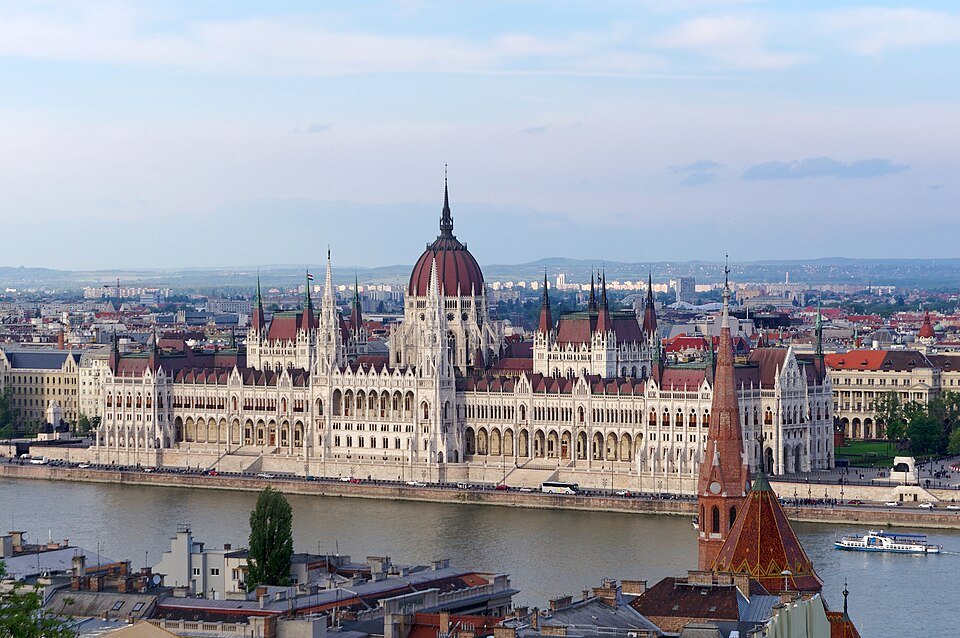
Photo: Wikipedia