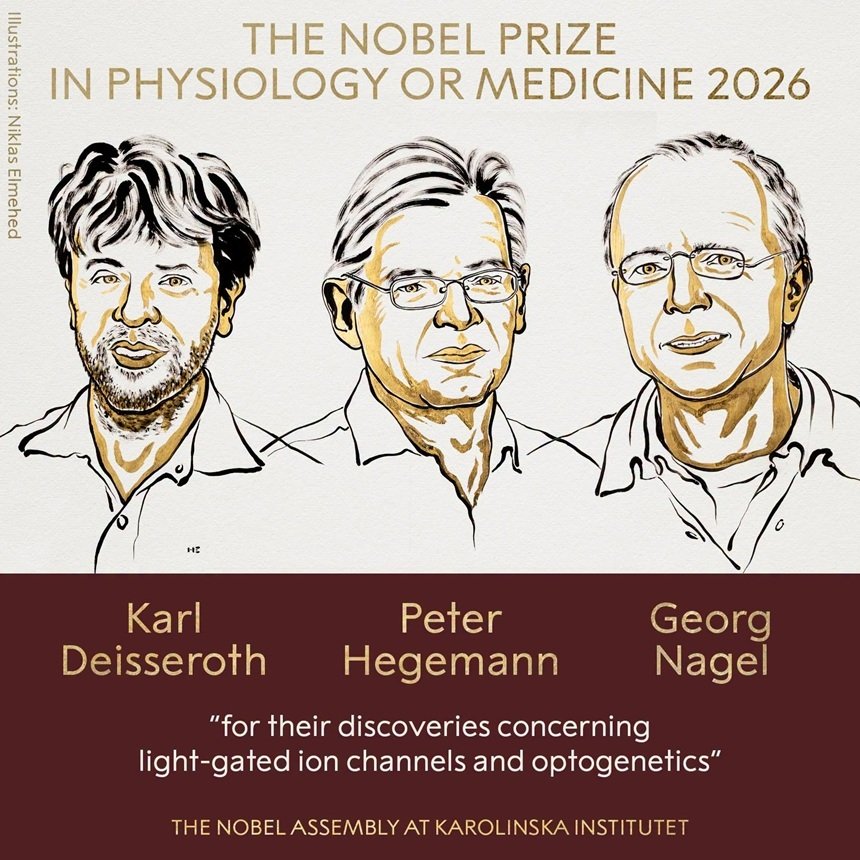
2026 Nobel Prize in Medicine awarded for breakthroughs in optogenetics
The 2026 Nobel Prize in Physiology or Medicine has been awarded to Karl Deisseroth, Peter Hegemann and Georg Nagel for their “discoveries concerning light-activated ion channels and optogenetics,” the Nobel Assembly at the Karolinska Institutet in Stockholm announced on Monday, according to NobelPrize.org, CE Report quotes MOLDPRES.
The announcement was made by Thomas Perlmann, secretary-general of the committee that awards the Nobel Prize in Physiology or Medicine.
The 2026 Nobel Prize recognizes optogenetics, a method that makes it possible to demonstrate how nerve cells shape memories, feelings and behaviors in the living brain. Peter Hegemann and Georg Nagel discovered a remarkable protein called channelrhodopsin in a single-celled alga. Karl Deisseroth then transformed the protein into a light-controlled switch for nerve cells. According to news.ro, the laureates laid the foundations for a new era in neuroscience.
Using optogenetics, researchers have been able to identify the neural circuits underlying specific memories, feelings and behaviors, including those relevant to neurological and psychiatric disorders. In clinical medicine, researchers are also using the method in attempts to restore vision in people with visual impairments.
Optogenetics has fundamentally changed our understanding of the brain. New discoveries continue to emerge, helping scientists unravel one of humanity’s greatest mysteries: how the extraordinary human brain works.
The Nobel Prize in Physiology or Medicine has been awarded 116 times to 232 laureates between 1901 and 2025.
Last year, Mary E. Brunkow, Fred Ramsdell and Shimon Sakaguchi received the prize “for their discoveries concerning peripheral immune tolerance.”
Three discoveries that changed medicine
Helicobacter pylori: In 2005, Barry Marshall and Robin Warren were awarded the Nobel Prize for their discovery that stomach ulcers are an infectious disease caused by the bacterium Helicobacter pylori.
HIV: In 2008, Françoise Barré-Sinoussi and Luc Montagnier were recognized for discovering the human immunodeficiency virus (HIV) in patients with swollen lymph nodes, a breakthrough that dramatically improved approaches to treating people with AIDS.
mRNA vaccines: In 2023, Katalin Karikó and Drew Weissman received the Nobel Prize for their discoveries concerning nucleoside base modifications that enabled the development of effective mRNA vaccines against COVID-19, contributing to the unprecedented speed of vaccine development during the pandemic.
The Nobel Prize in Physiology or Medicine is awarded by the Nobel Assembly at Karolinska Institutet in Stockholm, Sweden.
So far, 14 women have received the Nobel Prize in Medicine.
The youngest-ever Medicine laureate was Frederick G. Banting, who was 31 when he received the prize in 1923 for the discovery of insulin.
The oldest Medicine laureate was Peyton Rous, who was 87 when he received the prize in 1966 for his discovery of tumor-inducing viruses.
A father and son, Sune Bergström and Svante Pääbo, have each received the Nobel Prize in Medicine. Svante Pääbo was awarded the prize 40 years after his father.
The Nobel Prize announcements will continue on Tuesday with the Physics Prize, followed by Chemistry on Wednesday. The Nobel Prize in Literature will be announced on Thursday, the Nobel Peace Prize on Friday, and the Economic Sciences laureates on Monday, October 12.
Photo: Nobel Prize