New excavations at Italy's Villa of Poppaea open to visitors
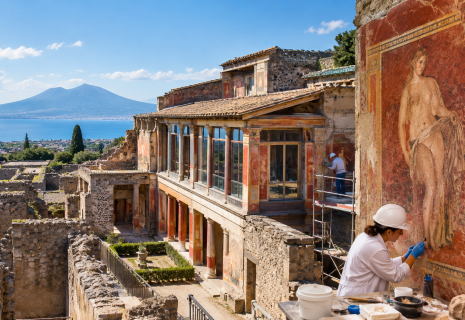
Kneeling on the ground, a restoration specialist scrapes with a scalpel the last layer of ash covering the base of a vibrant red fresco: at the Villa of Poppaea, near the ancient city of Pompeii, Italy, the latest archaeological excavations are now open to the public on Thursday mornings, AFP reports.
New spaces and their sumptuous painted decorations in the residence of Emperor Nero’s second wife can be visited by successive small groups of up to 10 people, who can watch archaeologists at work in real time, CE Report quotes AGERPRES.
Beneath the tall scaffolding supporting a metal roof, beyond the already arranged areas of the site, a narrow passage leads to the heart of the excavation, where pickaxes, scrapers and wheelbarrows are in use.
“Every excavation is a surprise. Of course, we expected to find some of the frescoes we could see on the opposite wall, but the surprises were far more numerous,” explained Arianna Spinosa, the architect leading the site.
“It is important (…) to begin reopening the villa and to show the whole world (…) what is happening, what cannot be seen from the outside” and “which is wonderful,” she added.
The luxurious Oplontis villa — named after the ancient suburb of Pompeii where it stood before being buried under ash after the eruption of Mount Vesuvius in 79 AD — was a holiday residence of Poppaea Sabina.
At the time of the eruption, the villa, which then faced the sea, was undergoing restoration, but the latest discoveries were made in the oldest part of the house, dating back to the mid-1st century BC.
Among them, on a bright yellow decorative frieze, appear the legs of a graceful bird, missing only its head.
That peahen, recently brought back to light in the open air, now stands face to face in the villa’s main salon with a peacock discovered during previous excavations, alongside a theatrical mask on the mirrored wall — “one of the most representative and legendary spaces of this villa,” said Arianna Spinosa.
The peacock, the sacred animal of the goddess Juno, “is one of the recurring motifs in the villa’s decorations,” explained chief archaeologist Giuseppe Scarpati.
Here, “the peacocks are perched on a balustrade in front of the entrance to a sanctuary identified as a sanctuary of Apollo,” he added.
Beyond the incredibly delicate subjects depicted — birds, fish, fruit — the brilliance of the colors is striking, some preserved in their original state.
“Virgin surfaces”
“This bright red panel bears original, untreated pigments, thus authentically preserved,” and “finally having pristine surfaces before us (…) allows us to considerably expand our knowledge,” Arianna Spinosa continued.
“Villa Poppaea is among the suburban and seaside villas that have always stood out for exceptional quality in both design and painting,” explained chief restorer Elena Gravina to the first site visitors.
“We identified, not only here but throughout the villa, pigments of cinnabar red and Egyptian blue, which at the time were very expensive and difficult to obtain and which testify to trade links, the wealth of the patrons, as well as the skill and expertise of the artisans,” she added.
Absorbed by the sumptuous painted décor of the cubiculum (small bedroom) and its stucco-adorned vault, Michele Iovine, 52, a regular visitor to the site, had for the first time the chance to speak with the restorers.
“I saw this cubiculum many times before the restoration work, then it was closed. Now it is certainly more legible, it has regained its original colors, it is displayed to its full potential,” he told AFP.
Although only 50% to 60% of the total surface of Poppaea’s villa has been excavated so far, the digs will most likely not stop here.
“We do not know its limits to the north, east or west. Therefore, the villa may still hold many more surprises,” Giuseppe Scarpati concluded.