Greece, Germany explore joint defence production, new technologies
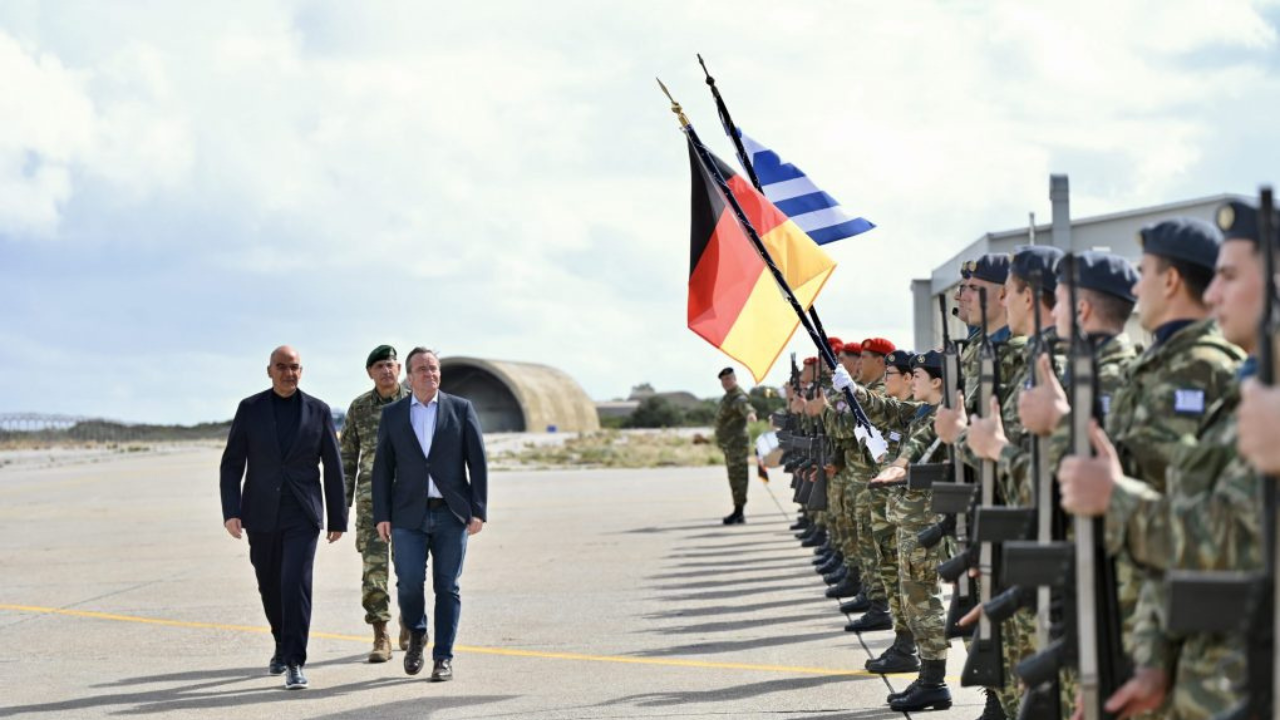
Greek Minister of National Defence Nikos Dendias welcomed German Federal Minister of Defence Boris Pistorius to the Crete Firing Range.
The two ministers held a bilateral meeting during which they exchanged views on key issues facing the defence ministries of the two countries within the framework of NATO and the European Union, CE Report informs via the Greek Ministry of National Defence's official website.
They also agreed to maintain regular contact on security issues and challenges affecting both sides.
At the end of the meeting, the Greek minister invited his German counterpart to visit Athens.
Dendias and Pistorius subsequently observed live-fire demonstrations involving the PATRIOT and LEFLASYS-OZELOT air defence systems, as well as a firing test and certification of the new IRIS-T SLM air defence system, as part of the “SPARTAN ARROW–26” air defence exercise.
The “SPARTAN ARROW” exercise is organised annually by the German Armed Forces at the NATO Missile Firing Installation (NAMFI) on Crete.
Also in attendance were Chief of the Hellenic National Defence General Staff General Dimitrios Choupis, Chief of the Hellenic Air Force General Staff Lieutenant General Dimosthenis Grigoriadis, German Ambassador to Greece Andreas Kindl, and senior military officers from both countries.
Dendias: Greece Wants to Strengthen Defence Ties With Germany
In a joint statement with his German counterpart, Greek Defence Minister Nikos Dendias said:
“Minister, dear Boris,
It is a great pleasure and a great honour to welcome you to Greece, and particularly to Crete, at a time when Europe's security faces such demanding challenges.
Both the Federal Republic of Germany and Greece are at the heart of developments, both within NATO and the European Union.
I want to state clearly that the Hellenic Republic is determined to strengthen its defence and military relations with Germany through more joint training exercises, hosting German forces in Greece, enhancing interoperability, and developing and acquiring joint platforms.
Both countries are at a critical juncture as they undertake a fundamental restructuring of their armed forces in response to the significant challenges we face.
In Greece, through our Agenda 2030, we are implementing this effort, with 2030 as the target date, as the name itself indicates. Germany has already announced an exceptionally ambitious and significant defence procurement programme. There is, therefore, considerable scope for cooperation.
This cooperation should extend beyond traditional sectors and conventional platforms to include cyber defence, unmanned systems, innovation and new technologies. We can move from straightforward cooperation to joint production and the development of shared capabilities.
Given our countries' different geographical positions on the European map, we have also had the opportunity to discuss the challenges facing Europe from a 360-degree perspective.
Because, as I think is easy to understand, security is not an abstract concept. It is an issue that affects our citizens on a daily basis.
We cannot ignore the broader geographical picture beyond the challenges we face in the north, particularly following Russia's invasion of Ukraine. North Africa, the Sahel and the Middle East are not distant or irrelevant regions for Europe. Peace, security and our economic resilience are also at stake there.
Another issue we discussed was European unity and a common European presence, including within NATO. Let me add that both countries believe in transatlantic cooperation and in NATO's future. We also believe that Europe's defence capabilities are not contrary to NATO; they complement the Alliance.
This is the common ground for European unity, on which I believe we can readily agree when fundamental interests are at stake.
I also had the opportunity to explain to the minister our perspective and how we view the security challenges in our region. I asked that we maintain regular contact so that, through open dialogue and a clear mutual understanding, we can address the issues that continuously affect our countries.
I would also like to thank Boris, the minister and my German counterpart, for today's meeting and our frank exchange of views. I reiterate my invitation for him to honour us with a visit to Athens following his visit to Crete, and assure him that the Hellenic Republic will always be an honest and sincere partner in dialogue with Germany.
Welcome to Crete, dear Boris.
Thank you,” said in the statement.
Photo Greek Ministry of National Defence