Jupiter, Saturn vortices reveal secrets of gas giants’ interiors
The secret of the giant vortices at the poles of Jupiter and Saturn lies in their structure, specifically in the chemical composition of their deeper layers.
This is shown by a study published in the Proceedings of the National Academy of Sciences, led by Jiaru Shi from the Massachusetts Institute of Technology, CE Report quotes ATA.
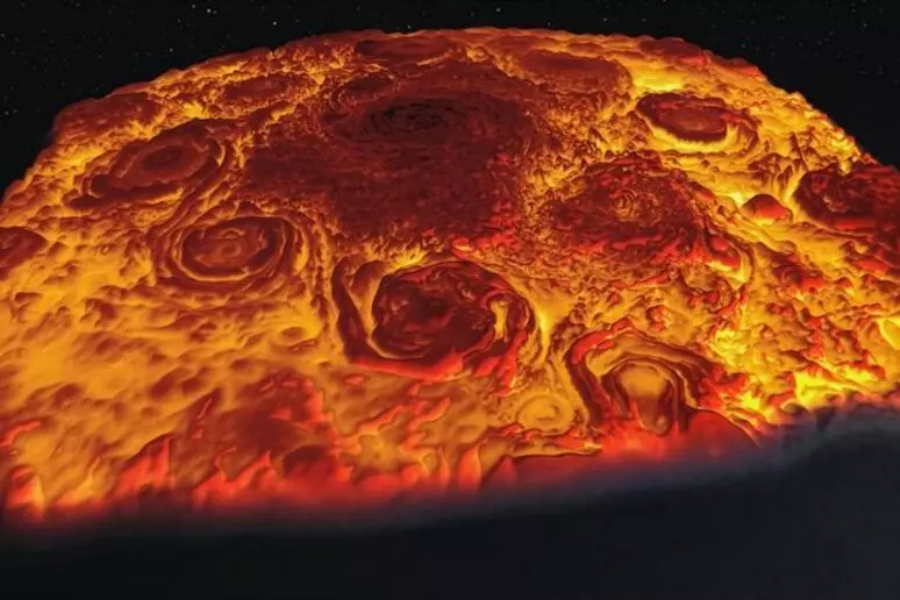
Space probes sent to study the two giant planets up close have shed light on many details and have also revealed some of their unique features, such as the giant vortices at their poles, caused by colossal and unusually shaped storms.
Saturn, in fact, has a single giant vortex with a strange hexagonal shape, while Jupiter’s vortex is surrounded by eight smaller vortices with diameters similar to that of Earth.
Since the two planets are similar in many aspects, such as size and composition, the major difference in their polar vortices is quite difficult to understand.
Newly published simulations show that differences in shape and structure may be due to characteristics present in the deeper layers of both planets.
In Jupiter, for example, beneath the meteorological vortex lies a layer of lighter materials that eventually blocks its growth and generates a cluster of smaller vortices.
However, on Saturn, there is a denser layer at the base of a vortex, allowing it to grow significantly and ultimately form giant structures.
"What we observe from the surface—the vortices on Jupiter and Saturn—can tell us something about their interiors," Shi said.
"Perhaps beneath the surface, Saturn is richer in metals and contains denser, more layered materials than Jupiter. This would expand our understanding of the gas giants," he added.