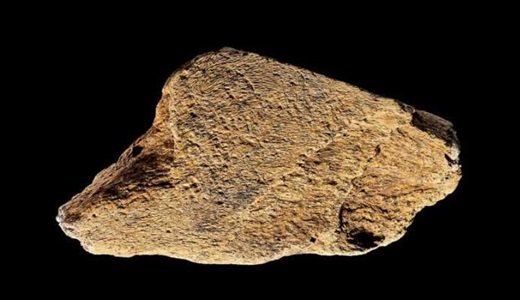
World’s oldest elephant-bone tool discovered in UK
A triangular artifact made from elephant bone and used to sharpen hand axes around 480,000 years ago has been discovered in the United Kingdom, according to a study published in the journal Science Advances, Live Science reported.
The object—measuring approximately 10.9 by 5.8 centimeters—is the oldest known elephant-bone tool ever discovered in Europe and demonstrates a high level of ingenuity and the ability of hominins to adapt to new environments as they settled in northern climates, CE Report quotes AGERPRES.
Although evidence suggests that early human relatives used elephant bones and tusks throughout the Paleolithic period for a wide range of activities, it is “very rare” to find an elephant-bone tool of comparable age anywhere in the world, said study co-author Silvia Bello, a paleoanthropologist at the Natural History Museum in London.
The “unexpected” discovery of one of the world’s oldest elephant-bone tools points to a relatively advanced level of technological development, highlighting the innovation, ingenuity, and craftsmanship of archaic hominins nearly half a million years ago, the researchers said.
Researchers do not know which group of hominins used the elephant-bone tool, given its age and the location where it was found, but the two main candidates are early Neanderthals or Homo heidelbergensis, Bello told Live Science via email.
The tool “offers an extraordinary glimpse into the ingenuity of the early human ancestors who created it,” Bello said.
The fossilized bone artifact was originally discovered in the early 1990s during excavations at the Boxgrove archaeological site in southern England. This internationally renowned site has yielded numerous discoveries that shed light on Paleolithic life around half a million years ago, including various bone and stone tools, many animal remains showing signs of butchery, and even the oldest human remains ever found in Britain.
The significance of the bone artifact was not immediately apparent. However, a recent analysis conducted by Bello and her co-author Simon Parfitt, an archaeologist at University College London’s Institute of Archaeology, revealed that the artifact is a fragment of elephant bone deliberately shaped into a sharpening tool used to shape and re-sharpen the edges of hand axes.
Such elephant-bone tools would have contributed to the production of finely crafted hand axes, which are believed to have been used mainly as cutting tools and are typical of the Boxgrove site, according to the study.
“The elephant-bone tool shows signs that it was shaped and used to grind and re-sharpen stone tools while the bone was still fresh, suggesting that these people knew elephant bone was an excellent material for this purpose,” Bello said.
The discovery represents the only documented case of an elephant bone being used to make such a tool, according to the researchers. Tools made from organic materials such as bone, antler, and wood were essential equipment for early humans but are rarely preserved in the archaeological record.
Moreover, prehistoric elephant-bone remains are “exceptionally rare” at Boxgrove, suggesting that archaic humans in the area rarely encountered this resource. Nevertheless, the toolmakers appear to have recognized its usefulness.
“This remarkable discovery demonstrates the ingenuity of our ancient relatives,” Simon Parfitt also told Live Science via email. “They possessed not only a deep knowledge of the local materials around them, but also a sophisticated understanding of how to create highly refined stone tools. Elephant bone would have been a rare but extremely valuable resource, and it is likely this tool was of considerable importance,” he added.