Serbia’s Student List presents reform agenda at EU Enlargement Forum (PHOTO/VIDEO)
By Aytan Aliyeva
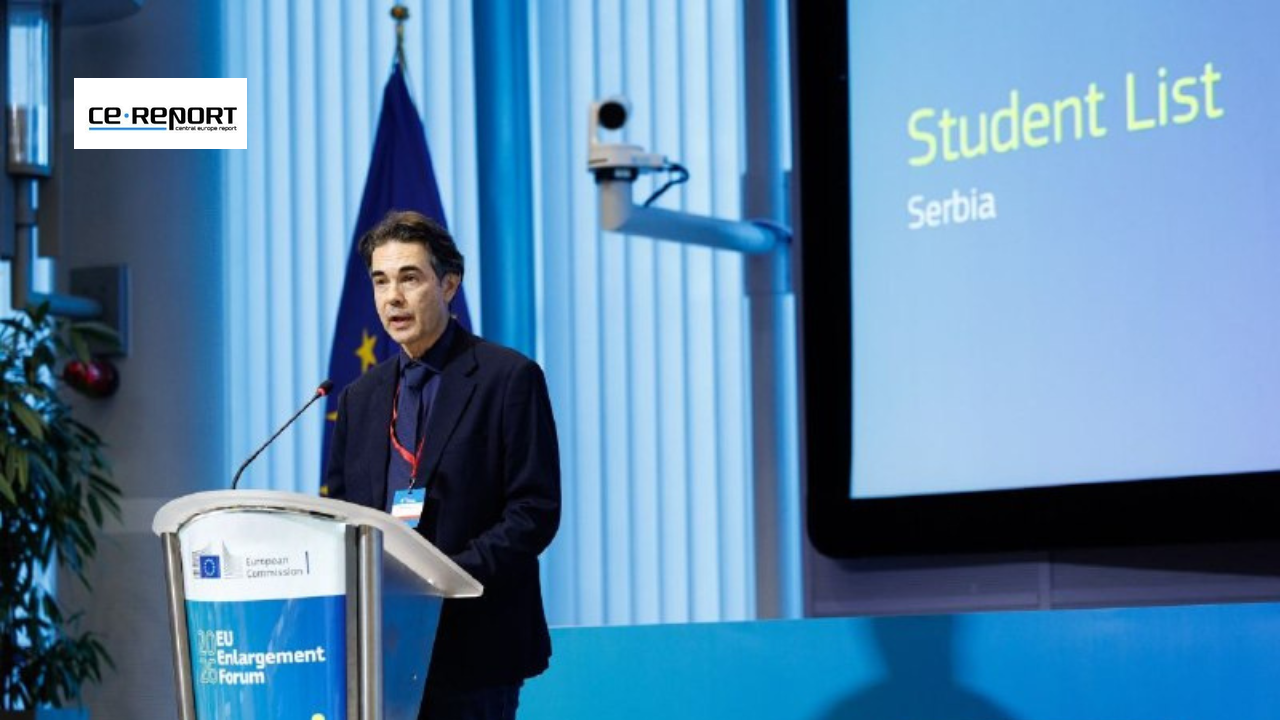
Aleksandar Baucal, a representative of Serbia’s Student List and newly elected member of parliament, outlined plans for institutional reform and cooperation with the European Union. Following the movement’s electoral victory in October, he identified progress on rule-of-law benchmarks, judicial independence and relations with neighbouring countries as priorities for the incoming government.
Student movement enters a new political phase
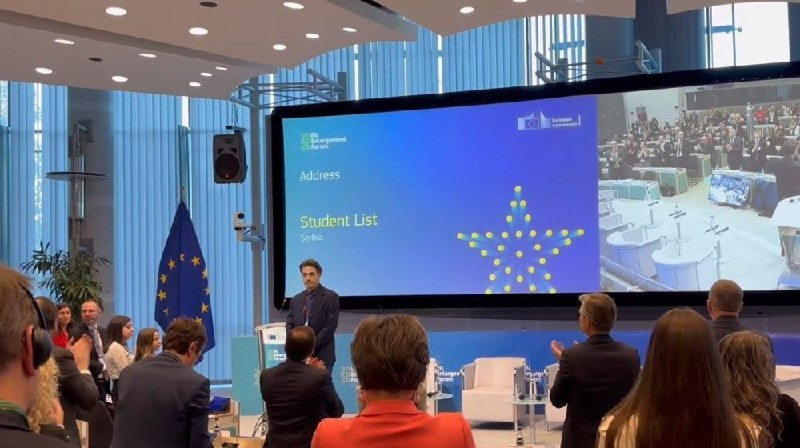
Professor Aleksandar Baucal, a psychologist at the University of Belgrade and newly elected MP, addressed the EU Enlargement Forum a day before the inaugural session of Serbia’s National Assembly on 17 November. His speech marked the Student List’s first public appearance before an international audience following its victory in the parliamentary elections on 25 October 2026. The movement, which emerged from nearly two years of student-led protests, defeated the Serbian Progressive Party associated with former President Aleksandar Vučić, ending its 14 years in power. The protests had brought together students and citizens demanding accountability, the rule of law and changes to the functioning of public institutions. Their electoral success marked a transition from protest mobilisation to parliamentary politics and the formation of a government. Baucal acknowledged that the Student List’s victory had raised questions about its plans for governing Serbia and the country’s relationship with the European Union. He identified three questions facing the movement: how it had won the election, what it intended to do after taking power and whether Serbia would remain on the European path. He presented the electoral result as an example of citizens overcoming political differences to pursue common objectives. However, he argued that the cooperation developed during the protests would need to be translated into institutions capable of representing citizens with different interests and political views.
European integration and institutional reform
Addressing the question of Serbia’s European future, Baucal described the European path as a process of reform, strengthening European values, establishing functioning institutions and developing an economy integrated into the European market. He also connected it with restoring relations with neighbouring countries and building a democratic society. He said the incoming government would work to restore the rule of law, strengthen judicial independence, protect media freedom and reform public administration. These measures were presented as priorities for Serbian citizens as well as requirements associated with the EU accession process. Baucal argued that the purpose of reform was to establish institutions that citizens could trust and that would function independently of political interests.
Among the Student List’s objectives, he identified accelerating progress on the interim benchmarks under Chapter 23, concerning the judiciary and fundamental rights, and Chapter 24, covering justice, freedom and security. Meeting these benchmarks and obtaining a positive Interim Benchmark Assessment Report (IBAR) would enable Serbia to advance towards the provisional closure of negotiating chapters.
The emphasis on these chapters reflected the connection between the movement’s domestic reform programme and the requirements of EU accession. Baucal presented cooperation with European institutions as a means of supporting changes that Serbia needed to undertake regardless of the timetable for membership.
Government formation and economic priorities
Baucal outlined the responsibilities awaiting the Student List after the constitution of the National Assembly and the formation of a government. The incoming administration was expected to involve experts across ministerial teams and begin discussions with EU institutions on individual policy areas. He advocated addressing disagreements through dialogue and beginning with issues that could be resolved through political decisions. Drawing on the student movement’s experience, he argued that cooperation among people with different perspectives could provide a basis for dealing with disputes within Serbia and with international partners. The reform agenda also includes economic development, environmental responsibility, transparency in public procurement, budgetary discipline and changes to policies concerning mining. Baucal identified education and healthcare as areas requiring attention and called for an economic model based on productivity, innovation and integration into the European market. He acknowledged that the tasks facing the incoming government would require cooperation with EU institutions and the implementation of reforms across several sectors.
Relations with neighbouring countries and the EU
Baucal said Serbia’s foreign policy should be based on fulfilling commitments, maintaining dialogue and resolving disputes rather than creating conflicts. He identified rebuilding trust with neighbouring countries as a priority and argued that Serbia should become a partner capable of contributing to European cooperation. He also stressed that cooperation with Brussels should not be understood solely as EU institutions assisting Serbia in protecting democracy. In his view, a democratic Serbia could contribute to Europe through its institutions, economy and relations with neighbouring countries. However, the speech did not establish how the Student List intended to address all the foreign-policy questions affecting Serbia’s accession negotiations. These include relations with Kosovo and alignment with the EU’s Common Foreign and Security Policy, particularly sanctions against Russia. The movement’s published foreign-policy programme maintains Serbia’s military neutrality and its policy of not imposing sanctions on Russia, while affirming respect for Ukraine’s territorial integrity. It also opposes Kosovo’s independence and membership in international organisations. These positions could complicate Serbia’s accession process, particularly because normalisation of relations with Kosovo forms part of the negotiating framework under Chapter 35. The programme identifies the EU as Serbia’s principal economic partner and supports progress on Chapters 23 and 24, but does not explicitly commit to EU membership. Baucal’s address therefore established a commitment to cooperation and domestic reforms without resolving the question of the country’s eventual accession.
Serbia’s relations with Brussels
Serbia applied for EU membership in 2009, received candidate status in March 2012 and opened accession negotiations in 2014. Since then, 21 negotiating chapters have been opened, while only two have been provisionally closed: Chapter 25 on science and research in December 2016 and Chapter 26 on education and culture in February 2017. Progress has been affected by concerns over judicial independence, media freedom, democratic institutions, relations with Kosovo and Serbia’s alignment with EU foreign policy. Relations between Brussels and Belgrade deteriorated during the previous administration, particularly amid the authorities’ response to protests and disputes concerning judicial reforms. The European Commission’s 2026 Enlargement Package recognised that the October elections had provided the incoming government with a mandate for reform. It also identified the need to reverse negative trends in democratic governance and fundamental rights.
The Student List has already established contacts with the European Commission. Its representatives met Enlargement Commissioner Marta Kos in Brussels to discuss institutional reforms and cooperation with EU institutions, including questions concerning European funding affected by the previous administration’s failure to meet reform conditions. During his address, Baucal also referred to the repression experienced by participants in Serbia’s protest movement. He expressed disappointment that parts of the international community had remained silent while demonstrators defended democratic principles, and thanked those who had supported them.
The speech concluded with a standing ovation from much of the audience at the forum.
Baucal’s intervention presented the Student List’s electoral victory as an opportunity to reform Serbia’s institutions and improve cooperation with the European Union. The incoming government’s progress will depend on implementing its commitments concerning the judiciary, public administration and fundamental rights, while its decisions on Kosovo, Russia and EU membership will determine the direction of Serbia’s accession process.
Gallery