Serbia holds “Winner 2026” tactical exercise with 2,000 troops, 500 military systems
A distinguished delegation attended the final phase of the “Winner 2026” joint tactical exercise with live-fire drills, held today at the Pešter temporary training ground.
The event was attended by President of the Republic and Supreme Commander of the Serbian Armed Forces Aleksandar Vučić, together with Defence Minister Bratislav Gašić and Chief of the General Staff of the Serbian Armed Forces General Milan Mojsilović, CE Report informs via the Ministry of Defence of Serbia's official website.
The exercise was also attended by Serbian Prime Minister Đuro Macut, Presidents of the National Assembly and Government of Republika Srpska Nenad Stevandić and Savo Minić, Serbian government ministers and Milorad Dodik.
Commander of the Serbian Army Major General Zoran Nasković served as the exercise planning officer, while Commander of the 2nd Army Brigade Brigadier General Nebojša Nedeljković was the exercise director at the Pešter temporary training ground.
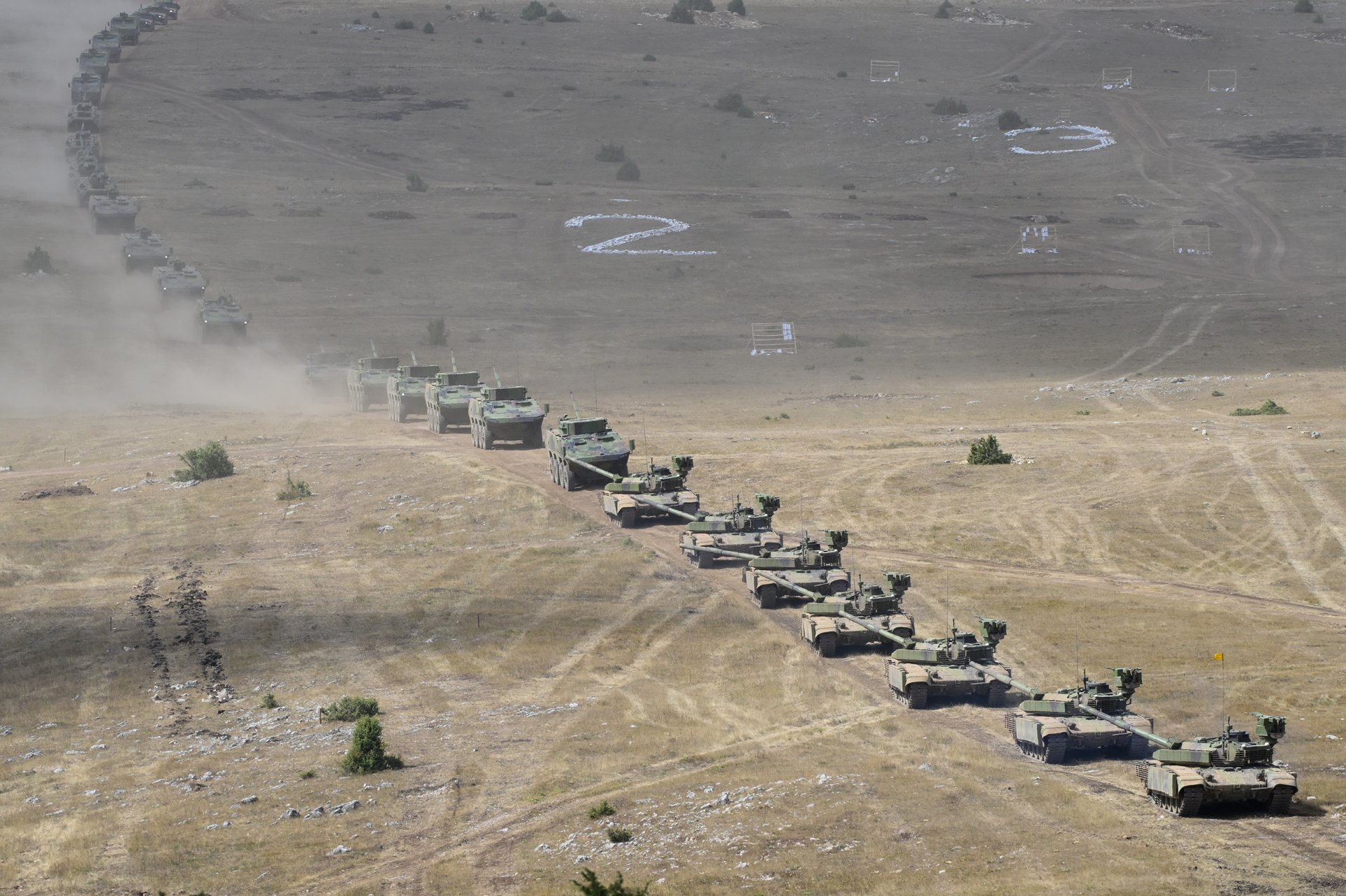
The military exercise involved coordinated units of the Serbian Army, Air Force and Air Defence, as well as Serbian Armed Forces special and military police forces. The aim of “Winner 2026” was to further improve the training and operational capabilities of commands and units in preparing for and conducting combat operations, coordinating joint action, cooperation and force protection. Newly introduced and modernised weapons and military equipment were used in the tactical and live-fire tasks.
Conducted under the scenario of an offensive operation, the exercise involved around 2,000 members of the Serbian Armed Forces and more than 500 major pieces of military equipment.
Activities at the Pešter temporary training ground began with reconnaissance of the enemy's combat deployment and the collection of intelligence in the area of operations using the CH-95 remotely piloted aircraft. Reconnaissance drones and multisensor reconnaissance platforms were also deployed for the same purpose. Air Force and Air Defence units were deployed to establish air superiority, while two MiG-29SM fighter aircraft conducted an airspace-clearing mission.
The enemy carried out a surprise incursion using small groups of drones and combat aircraft. Low-flying enemy targets were engaged by HQ-17AE, Mistral 3+, Strela-2M and PASARS missile systems, alongside the domestically developed Kobac-1 anti-drone system. The GM-200 radar system was used to detect enemy targets.
Air support was then authorised to isolate the battlefield. A group of MiG-29SM multirole combat aircraft conducted an attack using unguided 80mm rockets used against armoured vehicles, followed by strikes by modernised Orao fighter-bombers. Guided high-destructive-power air-launched munitions were subsequently employed.
To reinforce the forces, members of the 63rd Parachute Brigade were deployed from a C-295 transport aircraft using modern parachute systems. Following the successful airborne deployment, regrouping and organisation of the forces, operations continued on the ground. Reconnaissance companies were tasked with monitoring the area, detecting enemy presence in a timely manner and securing the movement of the main force.
Fire was opened on identified enemy positions, followed by the withdrawal of the units. During this phase, operations involving BRDM-2MS vehicles and Hummers equipped with 12.7mm remotely controlled weapon stations, NSV 12.7mm machine guns and Kornet anti-tank missile systems were demonstrated.
Anti-drone protection of the units was carried out by personnel armed with SCAR-L automatic rifles equipped with SMASH 3000 sighting systems and 40mm revolver grenade launchers. Sniper teams and Komarac K-2A drones engaged identified targets. After destroying enemy combat drones, members of the reconnaissance company withdrew on quad bikes, while the sniper pair was evacuated by a Hummer using the shortest route.
In the next phase of the exercise, rocket and artillery systems provided fire support for the attack, including the Oganj M24 with ALAS missiles, Perun and Nora B39 systems. After the enemy attempted to reinforce its forces, it was engaged with 82mm mortars, 30mm automatic grenade launchers and machine guns, alongside 155mm Nora B-52 self-propelled gun-howitzers.
After enemy forces were detected, fire was opened from M80 AB1v2 infantry fighting vehicles, M-83 anti-tank launchers using Maljutka 2F anti-tank guided missiles, and Kornet systems mounted on Hummer vehicles. Following the fire mission, Mali Miloš unmanned platforms took up advantageous positions to conduct observation and secure the area, allowing operations to continue while reducing the exposure of personnel to enemy fire.
To destroy enemy forces in a populated area, teams from the 72nd Special Operations Brigade, the 63rd Parachute Brigade and the Cobra Special Purpose Military Police Detachment were deployed. Modern Mali Miloš unmanned systems and unmanned aerial vehicles played a particularly important role, providing reconnaissance and surveillance using Vrabac and Senka drones, as well as fire support and other assistance to ground forces using Osica, Komarac K-2A, Komarac K-3 and IKA Bomber drones.
Following the operation of the unmanned platforms, special forces teams using Miloš 4x4 armoured vehicles, Hummers and quad bikes approached the populated area and, working alongside robotic dogs known as Robodog, neutralised the targets. The special forces teams then withdrew in an organised manner to a safe location in accordance with established safety measures, while reconnaissance of the enemy's deployment was conducted using the remotely piloted Senka aircraft.
To prevent enemy manoeuvring and neutralise its forces along the forward edge of the defence, Mi-35, H-145M and Gazelle helicopters provided close air support.
An artillery group consisting of two batteries of 155mm Nora B-52 self-propelled gun-howitzers and a company of 120mm mortars provided fire support for the attack and the deployment of the first combat echelon. Enemy forces were also engaged with 128mm M17 Oganj and 122mm RM-70 Vampire artillery systems.
Particular attention was drawn to the PULS multiple-launch rocket system, whose operation was demonstrated for the first time since its introduction into the Serbian Armed Forces. The system is a highly flexible artillery platform designed to conduct long-range strikes.
In the next segment of the exercise, an infantry platoon advanced in Lazar-3M combat vehicles, while elements of the tactical group moved along an auxiliary axis using Lazar-3M vehicles with 30mm guns and modernised M-84AS1/2 tanks.
During the advance, companies of modernised tanks, infantry fighting vehicles and the Lazar-3M platoon simultaneously engaged enemy forces using their available weaponry in order to penetrate deep into the enemy's positions and achieve superiority in the attack. M80AB1v2 infantry fighting vehicles, BOV POLO vehicles and Hummers equipped with Kornet systems, as well as MRAP vehicles, also took part. This was followed by the deployment of a second combat echelon consisting of BRDM-2M companies and an M-80 BTR platoon.
Following an assessment, the commander decided to further disrupt the enemy's deployment by deploying a parachute company in its rear. The first combat echelon then continued its advance deep into the enemy's positions, while forces engaged in the blocked populated area eliminated the remaining enemy elements.
The exercise also demonstrated the medical evacuation of wounded personnel by land and air, followed by assistance to local residents in affected populated areas.
The “Winner 2026” exercise demonstrated a high level of training, readiness and professionalism among members of the Serbian Armed Forces, as well as their ability to effectively employ new and modernised weapons, equipment and systems. It also demonstrated a high degree of coordination and cooperation in responding to contemporary security challenges, risks and threats to the Republic of Serbia.
Photo Ministry of Defence of Serbia