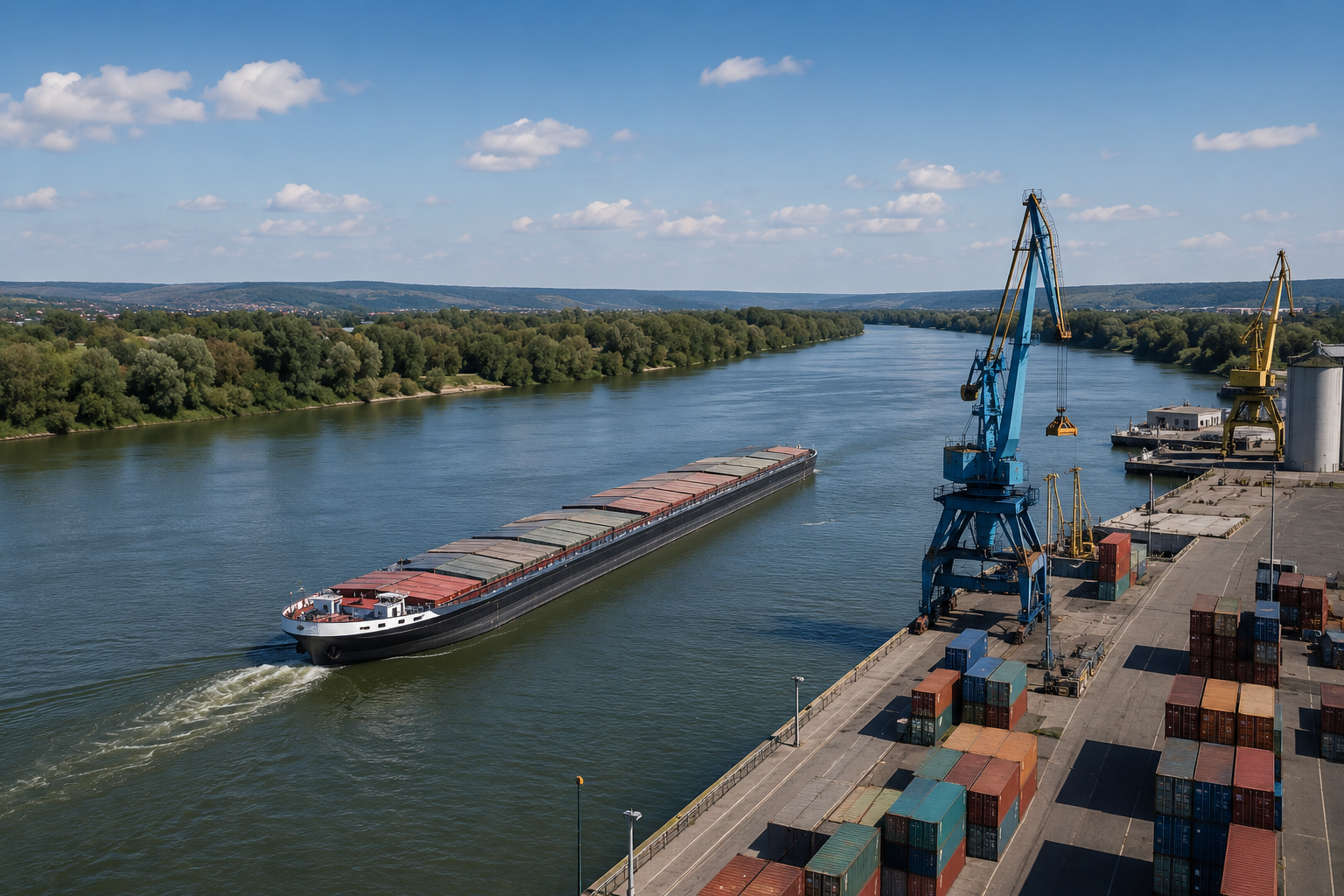
Transit dominates Bulgaria's river freight transport - EXCLUSIVE
Transit traffic continues to dominate Bulgaria's inland waterway freight transport, with more than 90% of cargo passing through the country rather than originating from or ending at Bulgarian river ports.
This was said by the source in the National Statistical Institute of Bulgaria in an exclusive interview with CE Report.
According to the source, Bulgaria's geographical position along the Danube—one of Europe's main inland freight corridors linking Central and Western Europe with the Black Sea—is the main reason transit cargo accounts for the overwhelming majority of inland waterway (IWW) freight transport. Between 2021 and 2025, transit traffic consistently represented between 88.8% and 95.9% of total IWW freight volumes.
The source explained that Bulgaria's domestic inland waterway market remains relatively small because the country has only one commercially navigable river of significance. As a result, most domestic freight continues to rely on road and rail transport due to the location of the country's production and consumption centers.
Despite annual fluctuations caused by economic conditions and international trade patterns, the overall structure of Bulgaria's inland waterway freight transport has remained broadly stable in recent years, with no clear trend toward a larger share of cargo originating from or destined for Bulgaria.
The source noted that the composition of goods transported by inland waterways changes from year to year depending on international trade, industrial production, and hydrological conditions on the Danube. Bulgaria's role as a transit corridor also significantly influences the country's cargo profile.
For assessing infrastructure needs, however, the amount of cargo loaded and unloaded at Bulgarian river ports is considered a more relevant indicator than total transit volumes. According to the latest data, transport volumes for agricultural products remained virtually unchanged, increasing only slightly from 1.182 million tonnes in 2024 to 1.187 million tonnes in 2025, while shipments of coal, lignite, crude petroleum, and natural gas declined marginally from 38,000 tonnes to 37,000 tonnes.
Based on these figures, the source said existing port infrastructure appears sufficient to handle current cargo volumes, at least in the short term.
The statistics also show no sustained structural shift toward any specific commodity group. Annual variations are mainly driven by changing demand for bulk commodities such as ores, coal, petroleum products, and agricultural goods, which account for most inland waterway freight moving through Bulgaria.
Given the dominant role of transit transport, developments in neighboring countries and changes in international supply chains continue to have a significant impact on Bulgaria's inland waterway freight statistics.
From a statistical perspective, the available data do not point to any long-term implications for Bulgaria's transport infrastructure or trade strategy. However, the source noted that if changes in the composition of transported goods become permanent over time, they could eventually increase demand for more specialized infrastructure at Danube ports.
The source emphasized that decisions regarding transport infrastructure development and national trade strategy fall exclusively within the responsibilities of Bulgaria's central and municipal authorities.
Photo: Chat GPT
This interview was prepared by Laura Hoffman